
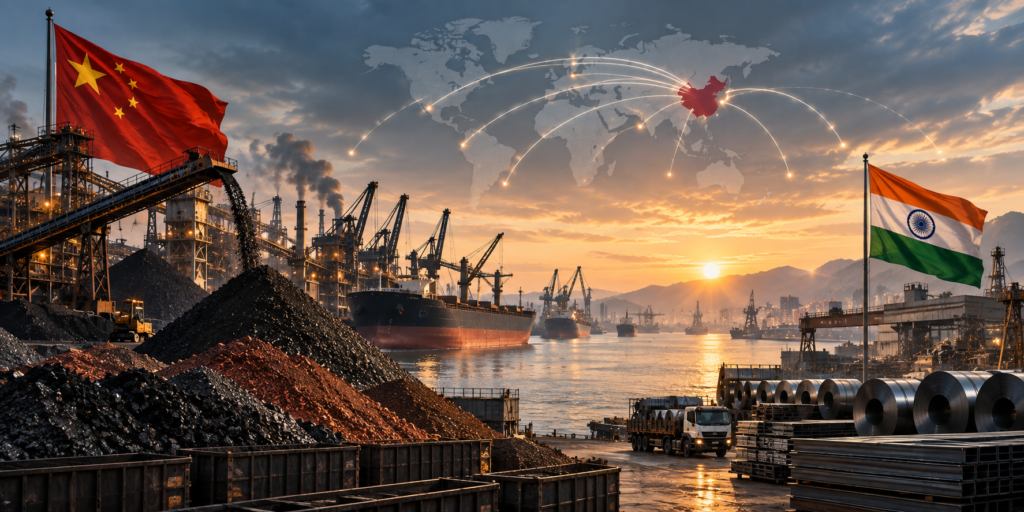
Why One Country’s Steel Production, Raw – Material Demand and Exports Continue to Influence Steel Economics Worldwide
There are more than 190 countries in the world, thousands of steel plants, hundreds of iron ore mines and an enormous global network trading coal, coke, scrap, pellets and finished steel.
Yet one country can still move almost every part of that system.
China.
In 2025, China produced roughly 961 million tonnes of crude steel, more than half of global production. India, the world’s second – largest producer, manufactured approximately 165 million tonnes. The gap alone demonstrates why relatively small changes in Chinese steel activity can translate into very large changes in global raw – material demand.
If Chinese mills increase production, more iron ore, coal and other inputs can be pulled into the system. If production slows, those materials have to find other buyers. If Chinese finished – steel exports rise, steel producers thousands of kilometres away can suddenly face additional competition in their domestic markets.
For India, this matters enormously.
China does not have to buy from India or sell directly to an Indian steelmaker for its decisions to affect Indian economics. Its influence can arrive through an Australian mine, an Indonesian coke producer, a bulk carrier, an international steel price or a cargo of finished steel arriving at an Indian port.
That is why, even as India develops into a steel powerhouse in its own right, understanding China remains essential to understanding the raw – material market.
The Mathematics Behind China’s Influence
The easiest way to understand China’s importance is through scale.
When a producer approaching one billion tonnes of annual steel output changes production by just 1%, the difference can be close to 10 million tonnes of steel on an annualised basis.
Ten million tonnes is not a small market adjustment.
It can translate into millions of tonnes of additional or reduced demand for iron – bearing materials, coal, coke and other inputs.
This is why global commodity markets pay close attention to Chinese steel production, construction activity, manufacturing, inventories, mill margins and government production policies.
- A 1% movement in a smaller steel market may remain local.
- A 1% movement in China can become a global raw-material event.
And 2026 has already illustrated that volatility. China was estimated to have produced 75.3 million tonnes of crude steel in January 2026, down 13.9% year-on-year, while India produced 15.1 million tonnes, up 10.5%.
The two largest steel producers were moving in opposite directions.
That creates interesting consequences upstream and downstream.
Iron Ore Feels China’s Pulse First
Few commodities demonstrate China’s influence better than iron ore.
China’s enormous blast – furnace steel industry requires equally enormous quantities of iron-bearing feed. That makes Chinese steel production, mill profitability and inventories important signals for the international iron ore market.
When Chinese mills are producing strongly, demand for ore can remain firm and seaborne cargoes find a large natural destination.
When steel production weakens, the equation changes.
Cargoes that might otherwise have been absorbed by Chinese buyers begin competing harder for demand elsewhere. Traders reconsider positions. Miners adjust sales strategies. Freight routes shift. Benchmark prices respond.
India may not be purchasing the exact cargo China rejected.
It can still experience the price consequence.
This is one of the strange realities of global commodity markets :
A buying decision in China can change the economics of a tonne being negotiated in India without that tonne ever travelling anywhere near China.
The Quality Question Makes It Even More Interesting
China does not simply influence how much iron ore the world consumes.
It can influence which qualities become more desirable.
When steel margins are strong and plants are prioritising productivity, higher – grade ore and pellets can become more attractive because better iron units can support furnace performance and reduce the burden created by gangue.
When margins tighten, mills may become more price-sensitive and reconsider the premium they are willing to pay for higher – grade materials.
That change in preference can ripple into pellet markets.
A pellet producer supplying international customers is therefore watching not only iron ore prices but also Chinese steel margins.
The effect can eventually reach Indian buyers through changing premiums, availability and competition for suitable iron – bearing feed.
China’s influence is therefore not simply about volume.
It can alter the value the market assigns to quality.
Coal and Coke Enter the Same Chain
The relationship becomes more complicated with coal and metallurgical coke.
Steelmaking coal markets depend on production from several major exporting regions, while coke markets are influenced by coal costs, coke capacity, energy prices and international trade.
China sits within this system simultaneously as a huge steel producer, coal consumer, producer and participant in international trade.
Changes in Chinese steel utilisation can therefore affect demand expectations throughout the metallurgical coal chain.
- If steel production rises, coke consumption requirements can strengthen.
- If blast – furnace utilisation falls, demand expectations can weaken.
- If domestic coal or coke economics change, international trade flows can respond.
For an Indian buyer, this matters even if its immediate supplier is located somewhere else.
Suppose demand from China strengthens for a particular raw – material origin.
More buyers are suddenly competing for the same tonnes.
- Availability tightens.
- The supplier gains pricing power.
- Freight demand may also change.
The Indian plant experiences a higher landed cost.
China never touched its cargo.
But China influenced its price.
Then Comes the Reverse Effect : Finished Steel
Raw materials are only half the story.
China can influence India from the opposite direction by exporting finished steel.
This is particularly important when Chinese domestic steel demand is weaker than production capability.
Material then looks for overseas markets.
India is one of them.
During April – July 2026, India imported approximately 2.77 million tonnes of finished steel, up 36.6% year-on-year. China was the single largest source, supplying about 856,000 tonnes – 30.9% of India’s total finished – steel imports during the period. India remained a net importer of finished steel over those four months.
This creates a completely different pressure on Indian producers.
An Indian mill can manage its coal carefully.
- Optimise coke.
- Improve pellet quality.
- Negotiate scrap.
- Reduce energy consumption.
- Improve yield.
And then find that the selling price of its finished product is being influenced by imported steel.
Raw-material efficiency therefore becomes even more important when finished-product pricing is under external pressure.
The China Effect Can Hit Both Sides of an Indian Steel Plant
This is what makes the relationship unusual.
China can influence the input side and the output side simultaneously.
On one side are iron ore, pellets, metallurgical coal, coke and other raw materials.
On the other is finished steel.
Imagine Chinese raw – material demand strengthens, helping push up the price of internationally traded inputs.
At the same time, excess finished-steel availability finds its way into export markets.
An Indian producer could theoretically face higher input pressure and greater finished – steel competition at the same time.
That is a difficult squeeze.
It also explains why steel profitability cannot be understood by looking at raw – material prices or steel prices independently.
The margin lives between the two.
Scrap Is Less Direct But It Isn’t Isolated
China’s influence on global scrap markets operates somewhat differently.
China is not simply another large buyer in the international ferrous scrap market ,its domestic recycling ecosystem and steelmaking structure create a more complex relationship.
But changes in Chinese steel production still matter.
If more steel is produced and consumed today, more steel ultimately enters buildings, vehicles, machinery and infrastructure. Over time, some of that becomes scrap.
At the same time, China’s movement toward electric – furnace steelmaking and greater recycling can influence the long-term availability of scrap for international trade.
For India, this matters because India is also expanding steel capacity while looking toward greater scrap utilisation.
The future competition may therefore not be for scrap in general.
It may increasingly be for clean, dense, low – residual scrap suitable for producing higher – quality steel.
China’s steel transition can help reshape that market too.
A Chinese Slowdown Is Not Automatically Good News for India
It can be tempting to assume that lower Chinese steel production is automatically positive for Indian buyers because raw – material prices may weaken.
Reality is more complicated.
Yes, reduced Chinese demand can relieve pressure on some internationally traded raw materials.
But weaker Chinese domestic steel consumption can also encourage greater finished-steel exports.
That may put downward pressure on prices in destination markets.
So an Indian steelmaker might save US$10 per tonne on one input while facing a much larger deterioration in the selling price of finished steel.
The correct question is therefore never simply :
Is China’s steel production rising or falling?
It is :
What does that change do to raw materials, finished steel and the margin between them?
For India, the Opportunity Is Becoming Smarter About the Signal
India’s long – term steel story is increasingly driven by its own domestic demand, infrastructure investment and industrial expansion.
That makes India progressively more important to global steel and raw – material markets.
But growing larger does not make China irrelevant.
It makes understanding China more valuable.
Procurement teams need to distinguish between temporary Chinese price movements and structural changes.
A fall in iron ore caused by short-term inventory adjustment is different from a sustained decline in steel production.
A temporary increase in exports is different from a structural domestic – demand shift.
A change in coke availability is different from a broader metallurgical coal shortage.
The strongest buyers therefore do not simply react to Chinese market movements.
They interpret why they are happening.
That difference can determine whether a company buys into temporary volatility or uses it strategically.
China Doesn’t Need to Buy Your Cargo to Change Its Price
The global steel market is gradually becoming more multipolar.
India is expanding rapidly.
New steel capacity is emerging across several regions.
Electric-furnace production is growing.
Scrap markets are developing.
Raw-material trade routes are changing.
Yet China’s sheer scale means its decisions continue to travel far beyond its borders.
A production cut can alter iron ore demand.
A recovery can tighten raw – material availability.
A shift in mill economics can change demand for higher-grade materials.
A weaker domestic market can redirect finished steel toward export destinations.
And those effects can eventually arrive in India as a different coal quotation, a changed pellet premium, a new coke price or greater competition in finished steel.
The Ripple Starts in China. Economics Can End Up in India.
The important question for Indian steelmakers and raw-material traders is no longer simply “What is China doing?”
It is “Which part of our cost, supply or selling market will feel it next?”