
The Exchange – Rate Chain Reaction From an Overseas Cargo to an Indian Furnace
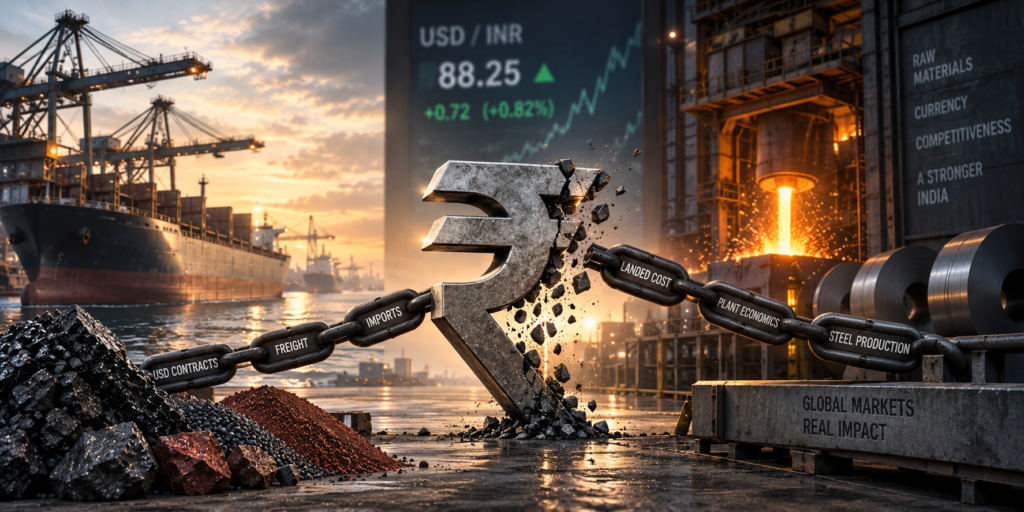
A steel plant can negotiate the same coal price on Monday and Friday and still end up paying more on Friday.
The supplier has not increased the price. The mine has not changed its quotation. The vessel is carrying exactly the same material. The international market may not have moved at all.
Only one number changed :
The rupee weakened against the US dollar.
For an Indian steelmaker dependent on imported coal, metallurgical coke and other internationally traded raw materials, currency is effectively another input cost. It does not arrive in a truck or sit in the stockyard, but it can quietly add lakhs or crores, to the landed cost of a cargo before that material ever reaches the furnace.
And because many commodity contracts and freight transactions are denominated in US dollars, the impact can travel through several layers of the steel supply chain at once.
The Simplest Example : Same Coal, Different Cost
Imagine an Indian buyer contracts imported metallurgical coal at US$200 per tonne.
At an exchange rate of ₹84 to US$1, the basic rupee value is :
$200 × ₹84 = ₹16,800 per tonne
Now imagine nothing changes internationally. The coal is still $200.
But by the time payment becomes due, the exchange rate has moved to ₹88.
The same coal now translates to :
$200 × ₹88 = ₹17,600 per tonne
That is an additional ₹800 per tonne without the supplier changing the dollar price by even one cent.
For a 50,000-tonne cargo, that difference becomes approximately ₹4 crore.
Coal did not become more expensive globally.
It became more expensive for India.
This is the first reason exchange rates matter so much in steelmaking : international commodity prices tell only half the story. The domestic buyer ultimately operates in rupees.
And the Dollar Exposure Doesn’t Stop at the Coal
A cargo’s final cost is rarely just its FOB material price.
There may be ocean freight, insurance and other internationally priced elements before the cargo reaches an Indian port. Then come domestic costs such as port handling, duties and taxes where applicable, financing, inland freight, storage and handling.
Suppose the material itself costs $200 per tonne and ocean freight adds another $25.
The foreign – currency exposure is now $225 per tonne, not $200.
At ₹84/$, that represents ₹18,900.
At ₹88/$, it becomes ₹19,800.
The currency movement alone adds ₹900 per tonne before several domestic landed-cost components are considered.
Across 50,000 tonnes, that is ₹4.5 crore.
This is why procurement teams cannot look at international coal or coke prices independently from currency.
The relevant number is the rupee landed cost.
A Falling Rupee Can Cancel Out a Falling Commodity Price
This is where the economics become particularly interesting.
Suppose metallurgical coal falls from $200 to $195 per tonne, a 2.5% reduction.
Internationally, that looks like good news.
At ₹84/$, $200 coal costs ₹16,800 per tonne.
But if the rupee simultaneously weakens to ₹88/$, the supposedly cheaper $195 coal becomes :
$195 × ₹88 = ₹17,160 per tonne.
So despite a $5 decline in the international coal price, the Indian buyer is paying ₹360 more per tonne in basic rupee terms than before.
The commodity chart says the market became cheaper.
The procurement ledger says otherwise.
This is why headlines such as “coal prices fell” or “coke prices softened” do not automatically translate into lower costs for Indian steelmakers.
The exchange rate can absorb the benefit or completely reverse it.
Imported Coke Feels the Same Pressure
Metallurgical coke follows a similar logic.
If an Indian plant or trader purchases imported coke through a dollar – denominated contract, rupee depreciation increases the domestic currency required to settle that transaction.
And coke is not an optional peripheral material for a blast – furnace operation.
It performs critical thermal, chemical and structural roles.
That means a sharp currency movement cannot always be solved by simply refusing to buy.
Production still requires material.
Inventory still has to be maintained.
The furnace does not wait for a better exchange rate.
This creates an important distinction between steel raw materials and many ordinary purchases: timing flexibility can be limited.
When stock coverage becomes tight, procurement may have to execute even when both the commodity market and currency market are unfavourable.
The Timing Gap Creates Another Risk
An overseas raw – material transaction does not happen instantly.
A contract may be negotiated today.
The cargo may load later.
The vessel may spend weeks at sea.
Payment may become due according to agreed commercial terms.
The material may then clear the port and move inland before finally reaching the steel plant.
During that period, the exchange rate can move.
This creates currency exposure between commercial commitment and actual payment.
A procurement team can therefore make what appears to be an excellent buying decision based on the commodity price and still see part of that advantage disappear before settlement.
This is why large importers do not simply ask :
“At what price did we buy the coal?”
They also ask :
“At what exchange rate is that dollar liability effectively costing us?”
This Is Where Hedging Enters the Conversation
Currency hedging is essentially an attempt to reduce uncertainty.
Rather than leaving the entire future dollar payment exposed to whatever USD/INR rate exists when settlement occurs, a company can use permitted financial instruments such as forward contracts or other treasury structures—to manage part of the exposure.
The objective is not necessarily to “beat” the currency market.
It is to create predictability.
Suppose a company knows it must pay US$10 million for future raw-material imports.
A ₹1 movement in USD/INR changes the rupee equivalent of that exposure by approximately :
₹1 crore.
If the rupee moves three rupees against the importer, the difference becomes approximately ₹3 crore.
At that scale, currency management becomes more than a finance – department concern.
It becomes part of raw-material cost management.
Of course, hedging itself involves costs, policies and trade – offs. If the rupee strengthens after an exposure has been hedged, the company may not enjoy the full benefit of that favourable move depending on the instrument used.
But the purpose is generally risk control, not speculation.
Currency Can Also Change Which Supplier Is Actually Cheaper
Imagine two coal offers.
Supplier A offers material at $190 per tonne from a distant origin with $30 freight.
Supplier B offers $198 material but requires only $18 freight.
Supplier A’s foreign – currency exposure is $220.
Supplier B’s is $216.
The cheaper FOB quotation is not actually the cheaper imported transaction even before quality differences are considered.
Now introduce exchange – rate volatility.
Every dollar of freight, insurance or material cost exposed to currency conversion magnifies the importance of evaluating the complete landed – cost structure.
This is why comparing suppliers only on FOB price can produce poor procurement decisions.
The furnace does not consume FOB prices.
It consumes landed material.
Then the Cost Travels From Procurement to Production
Eventually, the currency movement reaches the steel plant itself.
Higher imported coal or coke costs raise the raw – material cost of production. Depending on the production route and plant configuration, those increases influence the cost of hot metal and ultimately finished steel.
But steelmakers cannot automatically pass every additional rupee to customers.
Finished – steel prices are influenced by domestic demand, imports, global steel prices, inventories and competitive conditions.
That creates the real danger.
If raw – material costs rise because of currency depreciation while finished – steel prices remain relatively unchanged, the increase comes directly out of the producer’s margin.
The rupee therefore does not need to change furnace chemistry to affect furnace economics.
There Is Also a Working – Capital Effect
A weaker rupee does more than increase cost per tonne.
It can increase the amount of money required to finance inventory.
Suppose an imported raw-material inventory previously represented ₹100 crore of working capital.
If currency depreciation and associated landed-cost increases push the replacement value of that inventory higher, the company may need additional working capital simply to maintain the same physical stock coverage.
The plant still has 30 days of material.
But those 30 days are now more expensive to own.
For a large steel operation holding significant coal, coke and other imported inventory, this can become a substantial financial consideration.
Procurement strategy therefore has to balance two risks.
Holding too little inventory increases supply risk.
Holding too much expensive inventory increases working-capital pressure.
Currency volatility makes that balance harder.
The Rupee Can Even Change Procurement Timing
When currencies are relatively stable, procurement decisions can focus more heavily on commodity fundamentals – supplier availability, quality, freight and expected market direction.
When the rupee becomes volatile, another variable enters the timing decision.
- Should the company secure material now?
- Should part of the currency exposure be hedged?
- Should purchases be staggered rather than concentrated?
- Is the apparent decline in the commodity price meaningful after conversion into rupees?
- How much unhedged dollar exposure already exists across cargoes in transit?
The strongest procurement decisions therefore increasingly require coordination between procurement, treasury, logistics and operations.
The coal buyer cannot operate in isolation from the finance team.
The Real Number Is ₹ per Useful Tonne at the Plant Gate
For an Indian steelmaker, the most important number is ultimately not the international commodity quotation.
It is what usable material costs after everything has happened.
- Material price.
- Exchange rate.
- Ocean freight.
- Insurance.
- Port costs.
- Duties and taxes where applicable.
- Financing.
- Inland transportation.
- Handling.
- Quality adjustments.
- Moisture and yield effects.
Only then does the true economic comparison emerge.
A cargo quoted attractively in dollars can become expensive in rupees.
A slightly more expensive cargo can become competitive because of lower freight or better quality.
And a perfectly timed commodity purchase can become less attractive because the currency moved before settlement.
That is why sophisticated raw-material buying is increasingly about landed – cost intelligence, not simply price negotiation.
The Exchange Rate Never Enters the Furnace. Its Cost Does.
A blast furnace does not know whether the rupee is ₹84, ₹88 or ₹92 to the dollar.
It only knows the coal, coke and burden it receives.
But the company operating that furnace feels every currency movement long before the material is charged.
A weaker rupee can increase the cost of the cargo, freight and financing. It can alter working-capital requirements, change supplier economics and compress steelmaking margins, even when international commodity prices remain completely unchanged.
That is the hidden chain reaction.
- A number moves on a currency screen.
- A dollar invoice becomes more expensive.
- The landed cost changes.
- The raw-material budget changes.
And eventually, the economics of producing a tonne of steel change with it.
In imported raw materials, the price you negotiate is only half the deal. The exchange rate decides what that deal finally costs in India.