
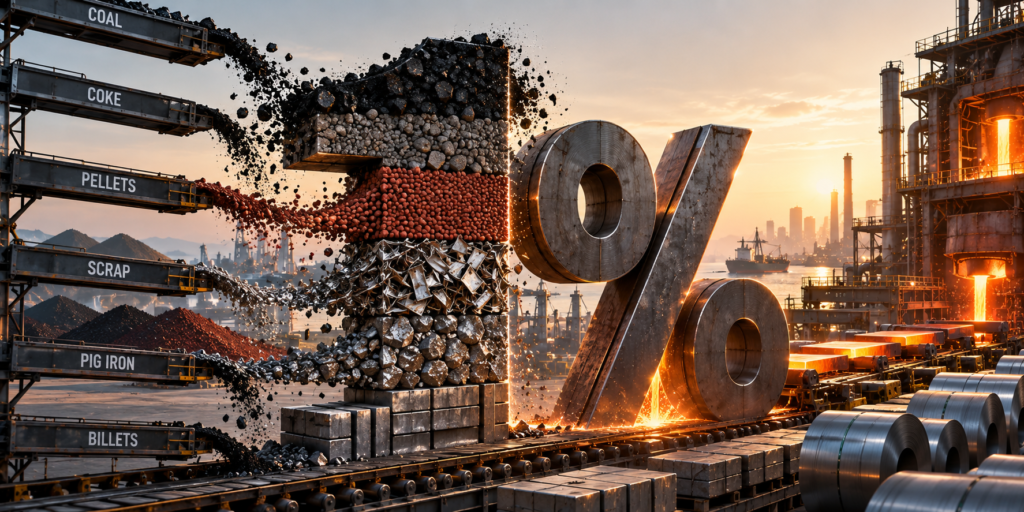
A mathematical look at what 1% more moisture, ash, fines, yield loss or residual contamination actually means
One percent sounds insignificant.
If a coal shipment contains 1% more moisture, it barely looks different. If pellet fines increase by one percentage point, the stockpile still looks like pellets. If scrap yield falls from 94% to 93%, both numbers appear respectable. If billet rejection rises by 1%, it can seem like a minor production variation.
But steel plants do not operate in kilograms.
They operate in thousands and millions of tonnes.
At that scale, percentages stop behaving like small numbers.
One percent of 100 tonnes is one tonne.
One percent of 100,000 tonnes is 1,000 tonnes.
And one percentage point repeated across several million tonnes of annual raw – material consumption can represent tens of thousands of tonnes of material, energy, yield or production.
This is the 1% Problem : tiny variations that look almost irrelevant on a laboratory report can become enormous once they are multiplied by steel-plant scale.
Start With the Simplest Calculation
Imagine a plant purchases 100,000 tonnes of coal.
At 8% total moisture, approximately 8,000 tonnes of that mass is water.
If moisture increases to 9%, approximately 9,000 tonnes is water.
That one-percentage-point increase represents roughly 1,000 additional tonnes of water within the same 100,000 – tonne mass.
The exact commercial consequence depends on contractual moisture adjustments and the coal’s analytical basis, but operationally the plant has more water to transport, handle and ultimately deal with.
If the coal costs an illustrative ₹12,000 per tonne on an as-received basis, 1,000 tonnes represents ₹1.2 crore of gross cargo value associated with that additional mass before contractual adjustments.
That does not mean the plant literally loses ₹1.2 crore – the commercial settlement may compensate for moisture but it demonstrates why one percentage point cannot be dismissed.
Then there is the thermal consequence. Additional water requires energy to heat and evaporate.
The percentage was small.
The tonnes were not.
Coal’s 1% Ash Problem Is Even More Interesting
Now replace water with ash.
Suppose a plant consumes 500,000 tonnes of coal annually and average ash rises from 10% to 11%.
That single percentage point represents roughly 5,000 additional tonnes of ash entering the process over the year, assuming the same coal consumption.
Ash does not contribute useful combustible energy.
Depending on where and how the coal is used, additional ash can increase the amount of inert material that has to be heated, handled and ultimately removed or managed.
In metallurgical applications, the consequences can extend into slag generation, flux requirements and overall process efficiency.
So procurement may celebrate a small saving on ₹/tonne while operations inherit thousands of additional tonnes of unwanted mineral matter.
This is why coal cannot be evaluated simply by asking :
What is the GCV and price?
A one – percentage-point movement elsewhere in the specification can materially change the economics.
Coke : 1% More Fines Means Less Useful Size
Metallurgical coke illustrates the same mathematics from a physical perspective.
Suppose a blast – furnace operation receives 300,000 tonnes of coke over a period.
If the proportion of undesirable fines increases by one percentage point, that represents approximately 3,000 tonnes shifting away from the preferred size distribution.
The problem is not merely the monetary value of those tonnes.
Blast furnaces depend on coke for more than heat and carbon. Coke also helps maintain permeability inside the burden so reducing gases can move effectively through the furnace.
The correct operational impact depends on where the fines are measured, screening arrangements and whether they are removed or recycled. But the underlying lesson remains powerful :
A laboratory or screening report may show a movement from, say, 5% to 6%.
Management sees +1%.
The material-handling system sees 3,000 tonnes.
Pellets : One Percentage Point Can Mean Thousands of Tonnes of Fines
Pellets create a similar problem.
Imagine a plant handles 1 million tonnes of pellets annually.
If fines generation or the proportion of below – size material increases from 3% to 4%, that additional one percentage point represents :
10,000 tonnes.
Ten thousand tonnes is no longer a rounding error.
Depending on the process and screening arrangements, additional fines may require separation, recycling or different handling. If excessive fines enter certain furnace burdens, they can negatively influence permeability and gas flow.
There can also be a logistics dimension.
The plant purchased, transported and handled one million tonnes.
But the proportion arriving in the most useful physical form has changed.
This is why physical specifications such as size distribution can deserve as much commercial attention as chemistry.
Scrap Shows Why Yield Can Matter More Than Purchase Price
Scrap provides perhaps the clearest financial demonstration of the 1% problem.
Suppose a steel plant buys 100,000 tonnes of scrap at ₹30,000 per tonne.
The purchase value is :
₹300 crore.
Now assume metallic yield is 94%.
The plant effectively recovers around 94,000 tonnes of useful metallic output from that input before considering the broader melt – shop mass balance.
If yield falls to 93%, useful recovery falls by approximately 1,000 tonnes.
At the original scrap purchase price of ₹30,000 per tonne, those 1,000 tonnes correspond to ₹3 crore of input value.
Again, actual economic loss is more complicated than simply multiplying tonnes by purchase price because slag, recovery, energy, alloying and process conditions all matter.
But the scale is unmistakable.
A procurement team can spend weeks negotiating ₹200 per tonne off a scrap contract.
Yet a one-percentage-point deterioration in metallic yield can overwhelm that saving.
The cheapest scrap per tonne can therefore become expensive steel.
Residuals Create a Different Kind of 1% Problem
With scrap, not every percentage issue is about yield.
Some are about chemistry.
Copper, tin and other residual elements can accumulate in recycled metallic streams and can be difficult to remove through conventional steel refining.
Here, even changes much smaller than one full percentage point can matter.
If scrap contamination pushes residual levels beyond the acceptable range for a particular steel grade, the plant may need to dilute the charge with cleaner metallic units such as DRI or pig iron, change its scrap mix or redirect the resulting steel toward a less demanding application.
This is an important reminder that 1% is not always the threshold.
In some areas of steelmaking, even tenths or hundredths of a percentage point can have commercial significance.
Steel is a business where tiny chemistry numbers can control very large quantities of finished product.
Pig Iron : Chemistry Multiplied by Tonnes
Pig iron is often valued partly because it provides relatively predictable metallic units and chemistry.
But consistency still matters.
Imagine a melt shop uses 200,000 tonnes of pig iron annually as part of its metallic charge.
A one-percentage-point change in a major constituent represents 2,000 tonnes of chemical difference across that annual volume.
Of course, steelmaking chemistry cannot be costed by simply multiplying those tonnes by the pig – iron price. The real impact depends on which element changes, whether it is desirable or undesirable, the furnace route and the final steel specification.
But that is precisely the point.
At industrial scale, a chemistry variation that looks small on a certificate can require changes in charge mix, refining practice, slag formation, oxygen consumption or alloy additions.
The certificate contains percentages.
The melt shop deals with tonnes.
Billets Turn 1% Into Finished – Product Loss
Now move downstream.
Imagine a rolling mill processes 500,000 tonnes of billets annually.
If billet – related defects, rejection or yield loss increase by just one percentage point, the affected quantity can be around:
5,000 tonnes per year.
Suppose the billet’s illustrative value is ₹45,000 per tonne.
Five thousand tonnes represents ₹22.5 crore of material value.
That does not automatically mean a ₹22.5 crore net loss. Some rejected material may be reworked, downgraded or recycled.
But every additional handling cycle has consequences.
- Reheating consumes energy.
- Re-rolling uses capacity.
- Scrapping creates recovery losses.
- Downgrading reduces realisation.
- Production schedules are disturbed.
A 1% billet – quality problem can therefore travel through the plant and become far larger than the initial rejection number suggests.
The Most Dangerous 1% Is the One That Repeats Every Day
A single off-spec shipment can be investigated and corrected.
The more expensive problem is often persistent small variation.
Suppose a plant processes 3,000 tonnes of a particular raw material every day.
A one-percentage-point disadvantage represents the equivalent of 30 tonnes per day in that particular measured component.
Over 30 operating days, that becomes 900 tonnes.
Across 330 operating days, it approaches 9,900 tonnes.
This is how small inefficiencies become structural costs.
They rarely trigger alarms because the plant continues running.
- Production continues.
- Material continues arriving.
- The furnace continues operating.
But every day, a tiny percentage quietly repeats itself.
By the time annual numbers are reviewed, the “small” variation has become thousands of tonnes.
Why Averages Can Hide the Problem
There is another danger.
Monthly averages can make variability look harmless.
Suppose the target moisture is 8%.
- Some shipments arrive at 6%.
- Others arrive at 10%.
- The monthly average may still show 8%.
On paper, procurement appears perfectly on specification.
Operationally, however, the plant did not receive a constant 8% material.
It received alternating dry and wet material that may have required adjustments in handling, blending or process control.
The same principle applies to ash, pellet fines, scrap density, residual chemistry and billet quality.
Averages describe the centre.
Plants operate through the variation around it.
That means the next level of raw – material management is not simply controlling averages.
It is controlling consistency.
One Percent Across an Entire Plant Becomes a Different Number Altogether
The real scale becomes visible when these effects occur simultaneously.
- A little more coal moisture.
- A little more ash.
- Slightly more coke fines.
- Higher pellet degradation.
- A small decline in scrap yield.
- Slight variation in pig-iron chemistry.
- A modest increase in billet rejection.
Individually, every department may report that its deviation is “only around 1%.”
But the steel plant does not operate as independent spreadsheets.
Those variations interact.
- Raw-material quality affects furnace efficiency.
- Furnace efficiency affects energy.
- Metallic yield affects tonnes produced.
- Billet quality affects rolling yield.
- Rolling yield affects saleable steel.
This is why a steel plant can lose substantial money without experiencing one dramatic failure.
Sometimes profitability disappears one percentage point at a time.
The Best Procurement Teams Don’t Negotiate Only Rupees. They Negotiate Percentages.
Raw – material procurement naturally focuses on price.
It should.
At steel-plant scale, even ₹100 per tonne matters.
But the same mathematical discipline needs to be applied to quality.
- What is one percentage point of moisture worth?
- What does 1% additional ash cost after the process impact?
- What is the economic value of reducing pellet fines?
- What does a one – point improvement in scrap yield save?
How much does billet rejection cost after reheating, recycling and lost rolling capacity?
Once these questions are quantified, quality stops being an abstract laboratory discussion.
It becomes financial data.
And that changes procurement conversations.
A supplier offering material ₹300 per tonne cheaper may no longer be cheaper if its performance creates ₹500 per tonne somewhere else in the process.
In Steel, 1% Is Never Just 1%
One percent is deceptive because our brains naturally interpret it as small.
Steel plants expose the weakness in that thinking.
- At 100,000 tonnes, 1% is 1,000 tonnes.
- At one million tonnes, it is 10,000 tonnes.
Attach energy, freight, processing, yield and finished-product value to those tonnes, and the financial consequence can quickly move from lakhs to crores.
That is why the strongest steel operations obsess over numbers that outsiders might consider insignificant.
- One percentage point of moisture.
- One percentage point of ash.
- One percentage point of fines.
- One percentage point of metallic yield.
- One percentage point of rejection.
Because at industrial scale, small numbers are not actually small.
The difference between an average steel plant and an efficient one may not be a dramatic breakthrough. It may simply be thousands of tiny percentages that somebody decided were worth controlling.