
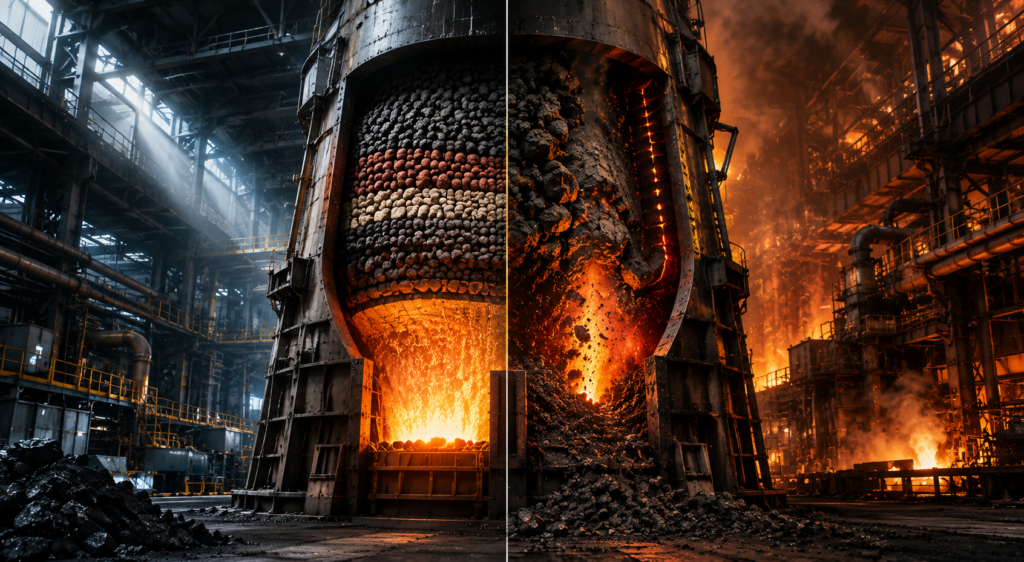
Why the Wrong Coal, Coke, Pellets, or Scrap Can Cost More Than You Think
Most steel plants spend significant time optimizing furnaces.
Engineers fine-tune :
- Air flow
- Temperature profiles
- Burden distribution
- Fuel rates
- Productivity targets
Yet one of the most expensive mistakes in steelmaking often happens before the furnace is even switched on.
The wrong raw material enters the system.
Not necessarily bad material.
Not poor – quality material.
Simply material that does not match the furnace it is being asked to perform in.
Because furnaces are not universal machines. Every blast furnace, DRI kiln, induction furnace, and EAF is designed around specific operating conditions.
When coal, coke, pellets, scrap, or pig iron fall outside those assumptions, performance begins to deteriorate.
Sometimes slowly.
Sometimes dramatically.
And often at a cost far greater than the apparent savings achieved through procurement.
The Biggest Misconception in Raw Material Procurement
A common belief across the industry is :
“If the specification is acceptable, the material should work.”
In reality :
Acceptable does not always mean optimal.
A furnace is designed around a narrow operating window.
When materials move outside that window :
- Fuel consumption increases
- Yield declines
- Productivity drops
- Maintenance requirements rise
The result is a mismatch between design intent and operational reality.
Why Furnace Design Matters More Than Most People Realize
Every furnace is engineered around assumptions regarding :
Raw Material Characteristics
- Size distribution
- Ash content
- Reactivity
- Strength
- Moisture
- Metallization
- Density
These assumptions influence :
- Gas flow
- Reduction rates
- Heat transfer
- Burden permeability
- Productivity
When the raw material changes significantly, the furnace must compensate.
And compensation usually costs money.
Coal : When Higher GCV Doesn’t Mean Better Performance
One of the most common procurement mistakes involves coal.
A higher GCV coal often appears superior.
After all :
More calories should mean better efficiency.
Right?
Not always.
Example Scenario
A furnace is designed around :
- 5,800 kcal/kg coal
- Moderate volatile matter
- Stable combustion profile
Procurement switches to :
- 6,800 kcal/kg coal
- Higher volatility
- Faster combustion characteristics
On paper :
The fuel is better.
Inside the furnace :
The combustion zone shifts.
Consequences
- Hot spots develop
- Temperature distribution becomes uneven
- Reduction efficiency declines
- Slag chemistry changes
The furnace wasn’t designed for that combustion profile.
The result is instability rather than efficiency.
Coke : Strength Matters More Than Price
Blast furnaces depend on coke for three purposes :
- Fuel
- Reducing agent
- Structural support
The third role is often underestimated.
Why Coke Strength Matters
A furnace burden weighing thousands of tonnes sits on top of coke.
As coke weakens :
- It breaks down
- Fines increase
- Permeability decreases
Typical Design Expectations
Many furnaces operate optimally with :
CSR :
- 62 – 68+
CRI :
- Below 25 – 28
When lower-strength coke enters the system :
- Gas flow becomes restricted
- Pressure drop increases
- Productivity declines
Productivity Impact
A 5 – 10% reduction in permeability can lower furnace productivity by :
- 3 – 8%
For a 1 million tonne operation, the financial impact becomes substantial.
Pellets : Not Every Pellet Works Everywhere
Pellets often appear standardized.
But pellet chemistry and physical properties vary significantly.
Important Variables
- Size distribution
- Compression strength
- Reducibility
- Gangue content
What Happens When Pellet Design Doesn’t Match the Furnace
A DRI kiln designed for :
- 10 – 12 mm pellets
May struggle with :
- 16 – 18 mm pellets
Larger pellets create :
- Slower reduction rates
- Uneven metallization
- Higher fuel consumption
Smaller pellets may create :
- • Excessive fines
- • Reduced bed permeability
- • Poor gas distribution
The furnace loses efficiency not because pellets are poor.
But because they are wrong for that specific system.
The Hidden Math of Pellet Size
A variation of only :
±2 mm
Can influence :
- Gas flow resistance
- Reduction kinetics
- Productivity
Some operations report :
1 – 3% productivity changes from pellet sizing alone.
For large-scale facilities :
That translates into crores annually.
Scrap : The EAF Challenge
Electric Arc Furnaces depend heavily on charge consistency.
Yet scrap variability remains one of the industry’s largest operational challenges.
Two Scrap Batches May Look Similar
Both classified as :
- HMS
- Shredded scrap
- Industrial scrap
Yet differ significantly in :
- Density
- Residual elements
- Contamination
Consequences
- Different melting profiles
- Different energy consumption
- Different chemistry corrections
Cost Impact
Poor – quality scrap can increase power consumption by :
15 – 40 kWh per tonne
For a 500,000 tonne EAF operation :
The annual cost impact can reach several crores.
Pig Iron : The Material That Often Fixes Mismatches
When scrap quality becomes inconsistent, many operators increase pig iron usage.
Why?
Because pig iron introduces :
- Stable chemistry
- Low residuals
- Predictable carbon
Pig iron effectively reduces variability.
It acts as a stabilizer inside the metallic charge.
In many modern EAFs :
Pig iron usage of :
10 – 25%
Can significantly improve :
- Melt consistency
- Yield
- Product quality
The Furnace Doesn’t Care About Purchase Price
This is one of the most overlooked realities in steelmaking.
A furnace does not know :
- What procurement paid
- Which supplier offered a discount
- How favorable the contract looked
The furnace only responds to material behavior.
And when behavior differs from design assumptions :
The system becomes less efficient.
The Hidden Costs of Mismatch
Most plants track :
- Material cost
- Freight cost
- Inventory cost
Few fully quantify :
- Yield loss
- Productivity reduction
- Fuel penalties
- Maintenance impact
Yet these often exceed procurement savings.
Example
A raw material discount saves :
₹500 per tonne
Annual volume :
100,000 tonnes
Savings :
₹5 crore
But if mismatch causes :
- 2% yield loss
- 3% higher fuel consumption
- Increased downtime
The operational loss may exceed :
₹10 – 15 crore
The apparent saving becomes a net loss.
Why High – Performing Plants Focus on Compatibility
Leading steel producers increasingly evaluate raw materials based on :
- Furnace suitability
- Consistency
- Operational fit
Not simply :
- Lowest landed cost
Their objective is not to buy the cheapest material.
Their objective is to maximize steel output per rupee spent.
Those are two very different strategies.
The Strategic Shift : From Procurement Thinking to System Thinking
Historically, raw materials were evaluated individually.
- Coal.
- Coke.
- Pellets.
- Scrap.
- Pig iron.
Today, leading producers increasingly evaluate them as a system.
Because every material influences :
- Heat generation
- Gas flow
- Chemistry
- Productivity
Changing one variable affects the entire furnace.
The Best Raw Material Is Not the Cheapest One. It’s the One the Furnace Was Built For.
Steelmaking efficiency is not determined by material quality alone.
It is determined by compatibility.
A premium raw material in the wrong furnace can underperform.
A moderately priced material perfectly matched to the system can outperform expectations.
The industry’s most successful operators understand a simple but powerful principle:
Furnaces are designed for specific behaviors.
When raw materials align with those behaviors, productivity follows.
When they don’t, the furnace spends every shift trying to compensate.
The Real Question Every Steel Plant Should Ask
Are we buying the best material available or the best material for the furnace we actually have?