
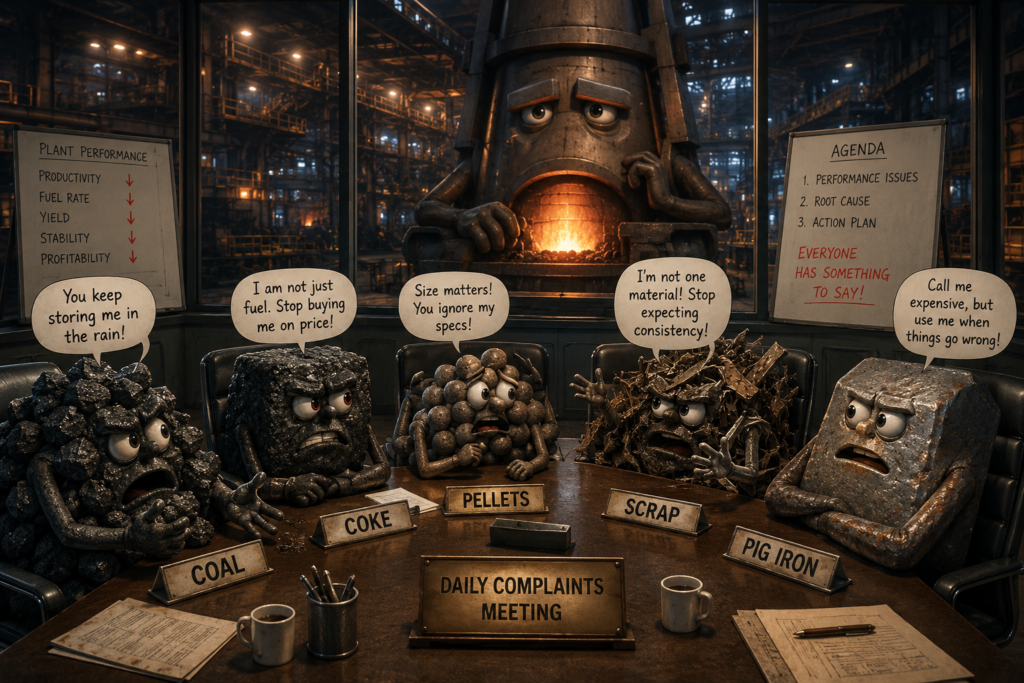
Every day, steel plants spend hours discussing productivity.
Meetings revolve around :
- Fuel rates
- Yield
- Throughput
- Downtime
- Costs
When performance drops, investigations begin.
Engineers review data.
Operators analyze temperatures.
Procurement teams compare invoices.
Consultants review process parameters.
Yet if the raw materials themselves could speak, they might offer a far simpler explanation. Because in many cases, the furnace isn’t struggling because of technology. It’s struggling because the materials feeding it were never given the conditions they needed to perform. Imagine for a moment that coal, coke, pellets, scrap, and pig iron had a voice.
The conversation inside a steel plant might sound very different. And surprisingly, many of the industry’s most expensive operational problems would suddenly become obvious.
Coal Speaks First
“You keep blaming me for fuel consumption, but you stored me in the rain.”
Coal is often judged entirely by its laboratory report.
- The shipment arrives.
- The GCV is checked.
- Ash is verified.
- Moisture is measured.
- The batch is approved.
Months later, operators wonder why performance has declined.
Meanwhile, coal is quietly asking :
“Have you seen what happened to me in the stockyard?”
The Reality
Coal changes over time.
Storage affects :
- Moisture
- Oxidation
- Volatile matter
- Size distribution
Research across industrial stockyards shows :
- GCV losses of 1 – 3% over extended storage periods
- Moisture fluctuations of 5 – 10%
- Significant increases in fines generation
What Coal Would Complain About
- Being stored too long
- Poor stock rotation
- Exposure to weather
- Constant rehandling
Coal’s Message
“I didn’t arrive inefficiently. You made me inefficient.”
Metallurgical Coke Joins the Discussion
“I am not just fuel.”
Few raw materials are misunderstood more than coke.
Procurement often compares coke primarily on price.
The furnace views coke differently.
Coke’s Job Description
Coke simultaneously functions as :
- Fuel
- Reducing agent
- Structural framework
Inside a blast furnace, coke literally supports thousands of tonnes of burden.
What Happens When Coke Quality Falls
If coke strength declines :
- Gas flow suffers
- Permeability decreases
- Pressure drop increases
A reduction in coke quality can lower blast furnace productivity by :
- 3 – 8%
Coke’s Complaint
“You keep asking me to support the furnace, then buy me based only on price.”
Pellets Enter the Meeting
“I wasn’t designed to fix poor burden planning.”
Pellets often receive praise when production is strong.
They receive blame when performance weakens.
Usually unfairly.
What Pellets Need
Consistent:
- Size distribution
- Burden design
- Gas flow
Most reduction systems are engineered around specific pellet characteristics.
What Pellets Hate
- Excessive fines
- Poor burden distribution
- Mixed quality charging
- Unstable operating conditions
A Typical Pellet Frustration
Imagine a DRI pellet speaking :
“You designed the kiln for 10–12 mm feed.
Then you charged everything from 6 mm to 18 mm and expected identical performance.”
The problem wasn’t the pellet.
The problem was the system.
Scrap Has Been Waiting To Say Something
“I am not one material.”
No raw material creates more surprises than scrap.
Because scrap is not a standardized product.
It is a collection of materials with vastly different histories.
What Scrap Wants People To Understand
Two scrap shipments may both be labelled :
- HMS
- Shredded
- Industrial Scrap
Yet contain :
- Different densities
- Different contaminants
- Different residual elements
What Happens Inside the EAF
Variable scrap creates :
- Variable melting behavior
- Variable energy consumption
- Variable chemistry
Additional power consumption :
15 – 40 kWh per tonne
is not uncommon when scrap quality fluctuates.
Scrap’s Complaint
“You keep expecting consistency from a material you never sorted properly.”
Pig Iron Finally Speaks
“I’m tired of being called expensive.”
Pig iron occupies a unique position.
It is often the first material questioned during cost reviews.
And one of the first materials appreciated during production crises.
What Pig Iron Brings
- Low residuals
- Stable carbon
- Predictable chemistry
When scrap quality declines, pig iron frequently becomes the stabilizer.
Pig Iron’s Complaint
“You complain about my price. Then quietly increase my usage every time melt consistency becomes a problem.”
The Furnace Finally Loses Patience
After listening to everyone, the furnace eventually speaks.
And its message is surprisingly simple.
The Furnace Says :
“Stop treating raw materials as separate purchases. I experience them as one system.”
This is where many operational problems begin.
Steel plants often evaluate materials individually.
- Coal.
- Coke.
- Pellets.
- Scrap.
- Pig iron.
The furnace experiences them simultaneously.
Changing one affects everything else.
The Hidden Cost of Making Materials Compensate for Each Other
A common industry habit is expecting one raw material to solve problems created by another.
What the Numbers Actually Say
A plant consuming :
500,000 tonnes annually
can experience significant losses from seemingly minor variability.
Examples :
1% Yield Loss
Potential impact :
5,000 tonnes steel lost annually
2% Higher Fuel Consumption
Potential impact :
Millions in additional energy costs
3% Productivity Reduction
Potential impact :
Reduced annual output worth several crores
Individually, these losses appear manageable.
Collectively, they become enormous.
The Biggest Complaint Nobody Hears
If all raw materials agreed on one thing, it would probably be this :
“Stop buying us based on specification sheets alone.”
Specifications are important.
But specifications do not tell the entire story.
They do not reveal :
- Storage practices
- Handling quality
- Blending strategy
- Furnace compatibility
- Operational consistency
The best-performing plants increasingly evaluate materials through a broader lens :
Not :
“What does the report say?”
But :
“How will this behave inside our process?”
The Lesson Hidden Behind the Humor
The steel industry often focuses on :
- Equipment
- Automation
- Technology
- Production targets
Yet many operational outcomes still originate with raw materials. The smartest plants understand that furnaces do not process specifications.They process behavior. And behavior is determined by how raw materials are selected, stored, blended, and utilized.
If Raw Materials Could Talk, Most Would Ask for the Same Thing
- Not a higher price.
- Not special treatment.
- Not better marketing.
Simply a better understanding of the role they play inside the system. Because coal, coke, pellets, scrap, and pig iron are not independent commodities. Together, they form the foundation of every tonne of steel produced. And when one of them struggles, the furnace notices immediately. Even if nobody else does.
The Question Every Steel Plant Should Ask
Are our raw materials underperforming or are they simply responding to the way we’re asking them to work?