
The hidden relationship between winter air quality, manufacturing and raw – material supply
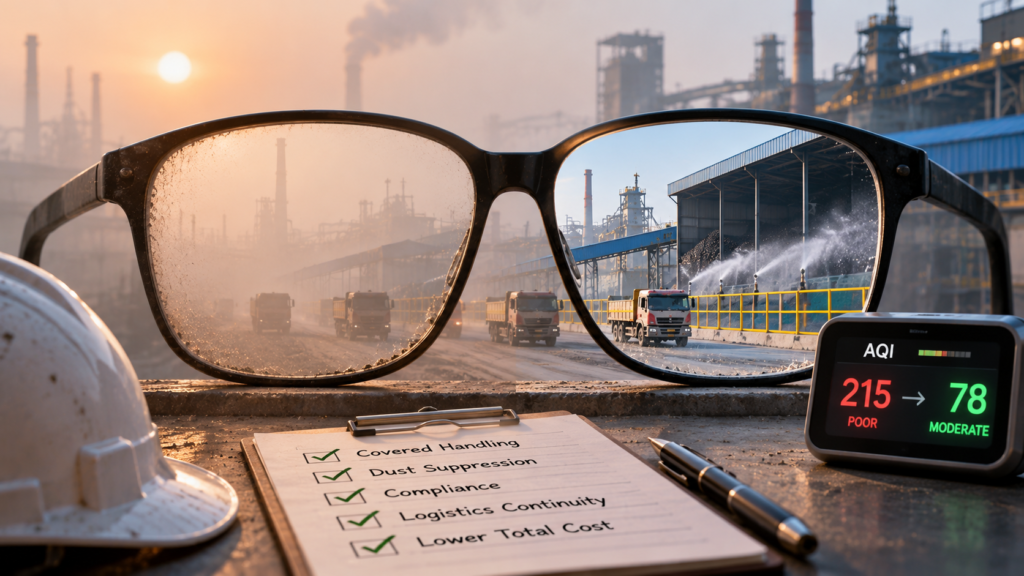
Every November, a familiar scene returns to parts of northern India.
The skyline disappears behind a grey haze. Air – quality readings become headline news. Schools face restrictions, construction activity comes under scrutiny, and governments introduce measures to control pollution.
But beyond the headlines, something less visible begins happening.
Industrial supply chains start adjusting.
Trucks may face additional operating restrictions. Dust-generating activities receive closer scrutiny. Stockyards need stronger controls. Manufacturing units may have to modify operations, increase monitoring or demonstrate compliance with environmental requirements.
For businesses dealing in coal, metallurgical coke, iron ore, scrap and steel, air pollution is no longer simply an environmental conversation.
It is increasingly an operational and commercial consideration.
And the economics can be surprisingly significant.
A steel plant may have secured the right raw material at the right price, arranged transportation and planned production. Yet a temporary restriction, a dust-control failure or a logistics bottleneck can change the landed cost and delivery schedule.
This is the emerging smog economy : a world in which air quality can influence how industrial materials are stored, transported, handled and ultimately consumed.
Why November Changes the Industrial Conversation
Winter pollution episodes are influenced by several interacting factors.
Lower atmospheric mixing heights, temperature inversions and weak winds can trap pollutants closer to the ground. Vehicle emissions, industrial activity, construction dust, road dust, biomass burning and other sources can contribute to deteriorating air quality.
In northern India, the problem becomes especially visible during October and November, when seasonal weather conditions and multiple emission sources can combine to create severe pollution episodes.
The result is greater regulatory attention.
In Delhi – NCR, for example, the Graded Response Action Plan ( GRAP ) provides a framework for escalating measures according to air – quality conditions. Depending on the stage and applicable directions, measures can affect construction activities, certain vehicles, industrial operations and other pollution – generating activities.
Not every restriction applies to every business, and the exact requirements depend on location, activity, fuel type, applicable permissions and the directions in force.
But the broader commercial lesson is important.
Industrial supply chains increasingly need to plan for environmental restrictions in the same way they plan for weather, transport capacity and delivery schedules.
A disruption lasting only a few days can matter when a plant depends on continuous raw – material movement.
The Hidden Cost of a Truck That Cannot Move
Consider a steel – related business that normally receives 100 truckloads of raw materials per day.
Assume an average payload of 25 tonnes.
That represents approximately 2,500 tonnes of material moving into the facility every day.
Now imagine a pollution – control restriction, transport bottleneck or compliance – related interruption delays 40% of those deliveries for three days.
The delayed quantity would be :
2,500 tonnes × 40% × 3 days = 3,000 tonnes
The material has not disappeared.
The supplier may still have the stock. The purchase order may still be valid. The trucks may even be ready.
But the plant does not have the material when it needs it.
If the affected material is critical to production, the consequences can extend beyond transport.
Inventory buffers begin shrinking. Production teams may need to alter schedules. Procurement may arrange alternative routes or suppliers. Logistics providers may charge for additional waiting, handling or rescheduling.
A ₹200 – per-tonne increase in the effective logistics cost of those 3,000 tonnes would mean an additional ₹6 lakh.
That is only the direct illustrative transport impact.
It does not include potential production disruption, emergency procurement or working-capital consequences.
This is how air – quality restrictions can become a commercial issue without changing the commodity’s underlying market price.
Coal and Coke : When Dust Becomes an Operating Cost
Coal and metallurgical coke are essential industrial materials, but their handling can generate fugitive dust if not properly controlled.
Unloading, conveying, screening, crushing, vehicle movement and stockpile management can all contribute to particulate emissions.
The extent depends on factors such as material size, moisture, handling methods, wind conditions and the effectiveness of installed controls.
During periods of heightened pollution scrutiny, these activities may receive additional attention from regulators and plant management.
That can make dust-control infrastructure particularly valuable.
Covered conveyors, enclosed transfer points, extraction systems, filtration equipment, properly designed storage areas and effective housekeeping can reduce uncontrolled dust release.
But these systems require investment.
Imagine a facility handling 500,000 tonnes of coal and coke annually.
If improved dust – control operations add an illustrative ₹40 per tonne in recurring handling and maintenance costs, the annual expense becomes ₹2 crore.
That is a meaningful number.
However, evaluating only the additional expense misses the larger picture.
Effective dust management can also reduce material losses, improve housekeeping, support regulatory compliance and lower the risk of operational interruptions.
The economics are therefore not simply about spending ₹2 crore.
They are about understanding what inadequate controls could cost the business over time.
The Stockyard Is Becoming Part of Environmental Strategy
Traditionally, stockyards have been evaluated primarily through capacity, accessibility and material – handling efficiency.
- How many tonnes can be stored?
- How quickly can material be unloaded?
- How efficiently can it be reclaimed?
Those questions still matter.
But environmental performance is becoming another important consideration.
Open stockpiles exposed to wind can generate dust, particularly when they contain fine or dry material.
Vehicle movement across unpaved surfaces can contribute to fugitive emissions.
Repeated handling can increase dust generation.
A poorly designed stockyard may therefore create both operational inefficiency and environmental exposure.
This is why facilities increasingly evaluate covered storage, wind barriers, paved roads, wheel-washing arrangements, appropriate dust suppression and improved conveyor systems.
However, dust suppression itself involves trade-offs.
Applying water can help control airborne particles, but excessive wetting of coal or coke may increase moisture and affect material-handling or process economics.
For certain materials and applications, adding water is not an acceptable solution.
The objective is not simply to eliminate visible dust at any cost.
It is to select controls that manage emissions without creating a new raw – material problem.
A well – designed system considers both environmental performance and material suitability.
The Economics of Cleaner Material Handling
Suppose a raw – material terminal handles 1 million tonnes annually.
Management is considering additional covered handling infrastructure and improved dust-control equipment.
Assume the project requires ₹8 crore in capital expenditure.
Spread over a hypothetical ten-year period, the capital cost alone is equivalent to ₹80 per tonne at a throughput of one million tonnes annually, before financing, maintenance, utilisation changes and other factors.
If annual operating and maintenance expenses add another ₹20 per tonne, the simplified combined cost would be around ₹100 per tonne during that period.
For a commodity trader or steel producer, that is not insignificant.
But the decision should not be evaluated only through the immediate cost per tonne.
The infrastructure may reduce uncontrolled dust, material losses and cleaning requirements while improving operational reliability and compliance.
If a facility operates in a location where environmental interruptions are a meaningful risk, improved infrastructure may also help protect continuity.
The commercial value of that reliability can be substantial.
Cleaner logistics is not automatically cheaper logistics. But poorly controlled logistics can become unexpectedly expensive.
Why Scrap and Iron – Bearing Materials Are Part of the Conversation
Coal and coke attract attention because dust is visibly associated with their handling.
But other raw materials also have environmental considerations.
Iron ore fines and certain pellet – handling operations can generate dust during transfer, screening and storage.
Scrap yards may face concerns relating to vehicle movement, handling practices, surface contamination and the management of non-metallic material.
Processing operations involving cutting, shredding or other activities may require appropriate emission – control measures depending on the equipment and applicable regulations.
The important distinction is that different materials require different solutions.
A dust – control approach suitable for an iron ore stockpile may not be appropriate for a scrap-processing facility.
Similarly, a covered conveyor may improve one operation, while another requires improved extraction, filtration or better traffic management.
Environmental compliance is therefore not a single piece of equipment that every business can install.
It is a series of decisions shaped by the material, process and location.
When Compliance Changes Supplier Competitiveness
Now consider two raw-material suppliers offering similar material at comparable prices.
Supplier A operates with established environmental controls, reliable covered handling arrangements and documented compliance procedures.
Supplier B offers a slightly lower price but depends on exposed handling infrastructure and operations more vulnerable to interruptions.
Which supplier is more competitive?
The answer depends on the buyer’s priorities and the actual operating circumstances.
But during periods of heightened environmental restrictions, Supplier A may offer greater delivery predictability.
That reliability has commercial value.
Suppose Supplier B is ₹150 per tonne cheaper on a 20,000 – tonne order.
The apparent savings is ₹30 lakh.
If a disruption creates additional handling, replacement procurement and logistics expenses exceeding ₹30 lakh, the cheaper supply becomes the more expensive decision.
This does not mean every supplier with advanced infrastructure is automatically better.
It means environmental resilience is becoming another variable in supplier evaluation.
Price, quality and delivery reliability remain important.
Compliance capability increasingly belongs in the same conversation.
The Problem With Treating Pollution Controls as a Seasonal Expense
One of the biggest mistakes industrial businesses can make is treating environmental management as something that matters only when pollution levels become severe.
A temporary increase in housekeeping or dust suppression may help address an immediate problem.
But it cannot always compensate for infrastructure that was never designed to control emissions effectively.
- If a stockyard generates excessive dust throughout the year, November merely makes the weakness more visible.
- If trucks routinely create large quantities of road dust, a winter pollution episode does not create that problem. It exposes it.
- If a material-handling system relies on uncontrolled transfer points, the underlying issue exists regardless of the season.
The strongest industrial operators therefore treat environmental performance as a year-round operating requirement rather than a November emergency.
That approach can make compliance more predictable and reduce the need for rushed operational adjustments.
What This Means for Raw – Material Traders in 2026
For raw-material trading businesses, the implications extend beyond the plant gate.
A trader’s responsibility is increasingly connected to the reliability of the entire delivery chain.
That means understanding not only where material comes from and what it costs, but also how it moves through ports, storage facilities, processing yards and transport networks.
- Does the supplier have dependable handling arrangements?
- Could a seasonal restriction affect a critical transport route?
- Is the material likely to require additional handling?
- Are alternative delivery arrangements available?
- Does the buyer have enough inventory flexibility to absorb a short interruption?
These are practical commercial questions.
They do not require every trader to become an environmental engineer.
But they do require an understanding that compliance, logistics and raw-material availability are interconnected.
In 2026, a successful commodity transaction is not merely one where the material was purchased at the right price.
It is one where the material can be delivered reliably, handled appropriately and used within the applicable operational and regulatory requirements.
The Air May Be Invisible. Its Cost Isn’t.
The annual conversation around winter pollution is usually dominated by air – quality readings, public – health concerns and government restrictions.
Those concerns are important in their own right.
But behind them lies another story : the way environmental conditions influence industrial economics.
- A delayed truck changes inventory.
- An exposed stockpile changes handling requirements.
- A dust – control system changes operating expenditure.
- A compliance interruption changes production planning.
- A better – equipped supplier may become more valuable even when its quoted price is higher.
For steel plants, coal suppliers, coke traders and raw-material businesses, the lesson is not that environmental controls are simply another expense.
It is that environmental performance and operational reliability are becoming increasingly connected.
And companies that understand that connection can make better decisions before seasonal pressure exposes weaknesses in their supply chains.
In the smog economy, the costliest thing may not be cleaner operations. It may be discovering too late what unreliable operations really cost.