
Why the smartest raw – material strategy isn’t finding perfection, but knowing which imperfections your process can afford.
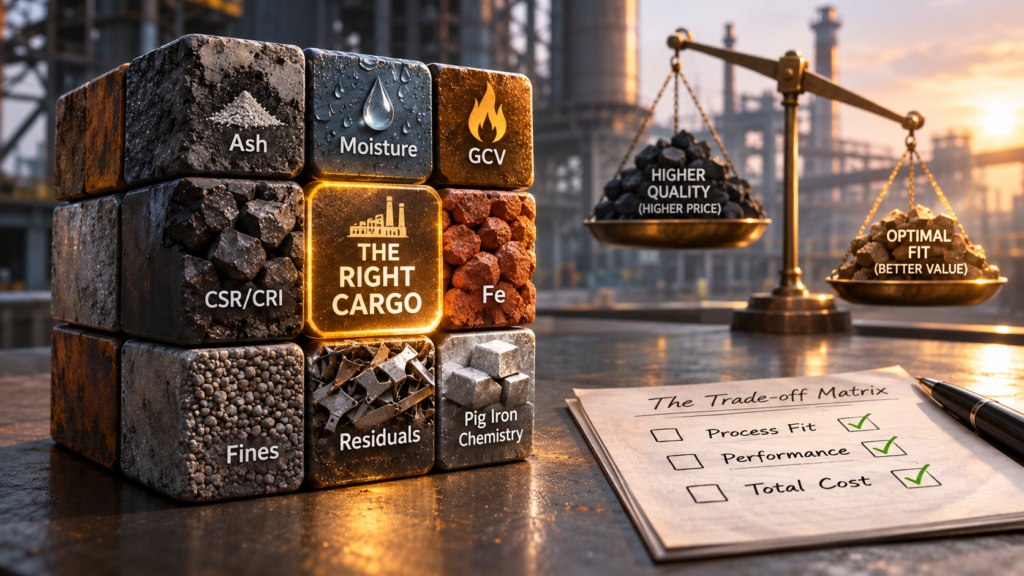
Imagine two steel plants buying the same raw material.
One chooses a premium-grade cargo with excellent specifications, minimal impurities and a higher price. The other chooses a slightly lower-grade cargo, accepts a few manageable imperfections and pays considerably less.
Six months later, the second plant has achieved better raw-material economics.
How?
Because the first plant paid for quality it didn’t necessarily need, while the second understood exactly what its process could tolerate.
This is one of the most overlooked realities of steelmaking.
The best raw material isn’t always the highest – quality raw material. It’s the material that delivers the required performance at the lowest sustainable total cost.
Every cargo comes with compromises. Coal contains ash and moisture. Coke varies in strength and reactivity. Pellets differ in iron content and fines. Scrap carries residual elements, while pig iron must match the chemistry of the intended melt.
The challenge isn’t eliminating every imperfection. It’s understanding which ones cost money, which can be managed and which are worth paying extra to avoid.
At the stee l -plant scale, that distinction can be worth crores.
The ₹500 Question : When Does Better Quality Become Too Expensive?
Consider two illustrative coal offers.
Cargo A : ₹11,500 per tonne, 10% ash, 8% moisture and 6,000 kcal/kg GCV.
Cargo B : ₹12,000 per tonne, 8% ash, 7% moisture and 6,200 kcal/kg GCV.
Cargo B appears superior. It has lower ash, lower moisture and higher calorific value.
But it also costs ₹500 more per tonne.
For a 50,000 – tonne shipment, that premium becomes ₹2.5 crore.
Now comes the important question: will those improved specifications generate more than ₹2.5 crore in operational value?
Lower ash may reduce unwanted mineral matter. Higher calorific value may reduce the quantity of coal required for a particular energy duty. Lower moisture may reduce unnecessary weight and drying requirements.
But the financial benefit depends on the application, equipment, efficiency and contractual terms.
If Cargo B delivers ₹3.5 crore in measurable operational benefits, the premium may be justified.
If it delivers only ₹1.5 crore, Cargo A could be the more economical purchase.
The same coal can therefore be a bargain for one plant and an expensive mistake for another.
Quality becomes valuable when the process can convert it into performance.
Coal : The Highest GCV Isn’t Automatically the Best Deal
Coal procurement often begins with calorific value.
Understandably so. Energy matters.
But comparing coal only through GCV can hide important differences.
Consider two coal options with energy values of 5,800 and 6,200 kcal/kg, measured on the same basis.
The second contains approximately 6.9% more energy per kilogram.
If both delivered that energy with identical efficiency, one tonne of the higher – GCV coal could theoretically replace approximately 1.069 tonnes of the lower – GCV coal for the same heat input.
But industrial processes are rarely identical.
Ash chemistry, volatile matter, moisture, grindability, combustion behaviour and furnace design can influence how effectively the energy is used.
A coal with excellent GCV but unsuitable ash characteristics may create penalties that offset its energy advantage.
A lower – GCV coal with stable combustion behaviour and favourable ash properties may perform more predictably.
The requirements also differ between thermal coal, pulverised coal injection applications and coal used for metallurgical coke production.
The smarter question is not simply, “Which coal has the highest GCV?”
It is “Which coal gives our process the lowest cost per unit of useful output?”
Moisture : How Much Water Can the Economy Afford?
Moisture is one of the easiest imperfections to underestimate.
Suppose a 50,000 – tonne coal cargo contains 10% moisture rather than 8%.
Within the same gross tonnage, that two – percentage-point difference represents approximately 1,000 additional tonnes of water and 1,000 fewer tonnes of dry material.
Depending on the commercial terms, moisture adjustments may protect the buyer from paying the full headline price for that difference.
But physically, the water still occupies transport capacity and can affect handling and processing.
Does that mean the driest coal is always worth buying?
Not necessarily.
Imagine a lower – moisture option costs ₹400 more per tonne.
Across 50,000 tonnes, the premium is ₹2 crore.
If the additional dry-material value and operational benefits exceed ₹2 crore, paying extra may make sense.
If they don’t, the wetter cargo could still be commercially attractive, provided it remains within acceptable operating limits.
Moisture isn’t simply something to minimise at any price.
It is something to measure, manage and price correctly.
Coke : When Strength Is Worth More Than a Discount
Metallurgical coke introduces another dimension to raw – material quality.
Unlike ordinary fuel, blast – furnace coke also performs a structural function. Its strength, size distribution and behaviour at high temperatures influence furnace operation.
Two important indicators are CSR, or Coke Strength after Reaction, and CRI, or Coke Reactivity Index.
In general, blast – furnace operators value coke that maintains sufficient strength after reacting and has suitable reactivity for their operating conditions.
Consider two illustrative coke offers.
One has a CSR of 65 and costs ₹32,000 per tonne.
Another has a CSR of 60 and costs ₹30,500 per tonne.
The difference is ₹1,500 per tonne.
Across 30,000 tonnes, that represents ₹4.5 crore.
For a blast furnace operating close to its permeability or productivity limits, the stronger coke may justify the premium.
For another operation with greater flexibility, the lower-cost coke may be acceptable.
However, CSR cannot be evaluated independently of CRI, ash, sulphur, size distribution and actual furnace performance.
Paying for unnecessary strength can be wasteful.
But underpaying for insufficient strength can be far more expensive.
Pellets : Higher Iron Content Doesn’t Tell the Whole Story
Iron ore pellets demonstrate why chemical and physical quality must be considered together.
Suppose a plant compares pellets containing 63% and 65% Fe.
Across a 100,000 – tonne cargo, the difference represents approximately 2,000 tonnes of contained iron.
That is significant.
Higher iron content can reduce unwanted material entering the process and may improve burden economics.
But imagine the higher – Fe cargo also contains more fines.
If fines increase from 3% to 5%, that represents an additional 2,000 tonnes of below – size material within the same gross cargo quantity.
Depending on the process, excessive fines can create screening requirements, recycling costs or burden – permeability challenges.
The plant has gained contained iron through chemistry but may face additional penalties through physical quality.
The correct decision requires evaluating both.
A higher – Fe pellet is not automatically the better purchase if its physical characteristics create costs that outweigh the benefit.
The chemical certificate and physical – quality report must be evaluated together.
Scrap : The Cheapest Tonne May Deliver the Most Expensive Steel
Scrap offers one of the clearest examples of why purchase price can be misleading.
Consider two illustrative scrap grades.
Scrap A costs ₹30,000 per tonne and delivers a metallic yield of 90%.
Scrap B costs ₹31,000 per tonne and delivers 95%.
At first glance, Scrap A is cheaper by ₹1,000 per tonne.
But calculate the purchase cost per recovered tonne.
Scrap A : ₹30,000 ÷ 0.90 = ₹33,333 per recovered tonne.
Scrap B : ₹31,000 ÷ 0.95 = ₹32,632 per recovered tonne.
Despite its higher purchase price, Scrap B is approximately ₹701 cheaper per recovered tonne, before considering other operating costs.
That difference becomes substantial across tens of thousands of tonnes.
But metallic yield is only part of the equation.
Residual elements such as copper and tin can create difficulties for certain steel grades because they are challenging to remove through conventional refining.
For a producer manufacturing demanding flat-steel grades, low-residual scrap may justify a premium.
For a producer manufacturing grades with greater tolerance for those elements, paying the same premium may be unnecessary.
The smartest scrap strategy is not buying the cleanest material available.
It is selecting a charge mix that achieves the required chemistry, yield and melting performance at the best total cost.
Pig Iron : When the Right Chemistry Matters More Than the Price
Pig iron presents an interesting contradiction.
It contains carbon and other elements that must be accounted for during refining, yet it can also help balance the chemistry of a scrap-based charge.
Consider a melt shop using 100,000 tonnes of metallic inputs.
If 15% of the charge is pig iron, that represents 15,000 tonnes.
Increasing the share to 20% means purchasing an additional 5,000 tonnes of pig iron while replacing an equal gross mass of another metallic input.
If pig iron carries an illustrative ₹3,000 – per – tonne premium over the material it replaces, the additional purchase-price exposure is ₹1.5 crore.
Would that be worthwhile?
It depends on the chemistry and operating benefits.
Pig iron may help dilute undesirable scrap residuals, improve charge consistency or influence metallic recovery.
But it can also change carbon balance, refining requirements and other process costs.
The decision cannot be made through purchase price alone.
Pig iron is most valuable when its chemistry solves a problem that would otherwise cost the plant more money.
The Hidden Cost of Demanding Perfection
Every additional specification can reduce the number of acceptable suppliers.
A buyer may demand exceptionally low ash, minimal moisture, tight size distribution, superior physical strength and extremely consistent chemistry.
Individually, each requirement sounds reasonable.
Together, they can make sourcing significantly more difficult.
Availability may become less reliable. Lead times may increase. The buyer may become dependent on a smaller group of suppliers.
And when demand rises, the premium for those narrow specifications can increase.
Imagine a plant consuming 500,000 tonnes of a particular material annually.
A premium of just ₹800 per tonne represents ₹40 crore in additional annual procurement expenditure.
If the improved specifications genuinely create more than ₹40 crore in operating benefits, the investment may be justified.
But if the plant could operate equally well with slightly wider tolerances, it is paying ₹40 crore for quality it does not need.
Perfection is expensive.
And sometimes, the process never asked for it.
The Real Skill Is Knowing Where Not to Compromise
This doesn’t mean steel plants should relax every quality requirement.
Some specifications are non – negotiable.
Hazardous contamination in scrap cannot be treated as an acceptable discount opportunity.
Certain residual elements may make material unsuitable for a particular steel grade.
Coke performance may be critical to blast – furnace stability.
Excessive fines may create serious operational difficulties.
And unsuitable coal characteristics may affect the intended process.
These are not imperfections to casually absorb.
They are operating boundaries.
The real skill lies in separating critical limits from commercially manageable variations.
A plant may tolerate slightly higher moisture if the price compensates for the actual cost.
- It may accept lower Fe content if the overall burden economics remain favourable.
- It may use less expensive scrap when the required steel chemistry allows.
- And it may purchase stronger coke only when furnace conditions justify the premium.
The best procurement strategy isn’t equally strict about everything.
It is exceptionally strict about the things that matter most.
The Shift From Price Per Tonne to Cost Per Outcome
A sophisticated raw – material decision brings procurement, laboratory data, operations and finance together.
Instead of comparing cargoes only by their quoted price per tonne, the plant evaluates what happens after the material arrives.
- For coal, that may mean cost per unit of useful energy.
- For coke, it means relating quality to actual furnace requirements.
- For pellets, it means evaluating usable iron units alongside physical quality.
- For scrap, it means considering recovered metallic yield, chemistry and melting performance.
- For pig iron, it means understanding how the material affects the complete metallic charge.
The objective is to calculate the total cost of using the material, not merely the cost of purchasing it.
This also changes the role of the raw – material supplier.
A supplier who understands a customer’s operating requirements can recommend material that fits the process rather than automatically offering the highest specification available.
That is a more intelligent approach to raw – material trading.
And it creates value for both sides of the transaction.
The Winning Cargo Isn’t Perfect. It’s Right for the Process.
Every raw material has imperfections.
Coal contains ash and moisture. Coke varies in strength and reactivity. Pellets differ in iron content and physical durability. Scrap carries residuals and yields uncertainty. Pig iron must be matched to the chemistry of the melt.
Trying to eliminate every variation would make procurement extraordinarily expensive and often unnecessarily so.
The strongest steel plants understand something more useful.
- They know which parameters must never be compromised.
- They know which variations can be managed.
- They know what those variations cost.
- And they know when paying for higher quality creates real value rather than simply a better-looking certificate.
Because the best cargo is not the one with the most impressive specifications.
It is the one that delivers the best combination of quality, reliability, operational performance and total cost.
In steelmaking, perfection isn’t the absence of imperfections. It’s knowing exactly which imperfections you can afford and which ones you can’t.