
As new steel capacity grows, can coal, coke, pellets, scrap and iron units keep pace?
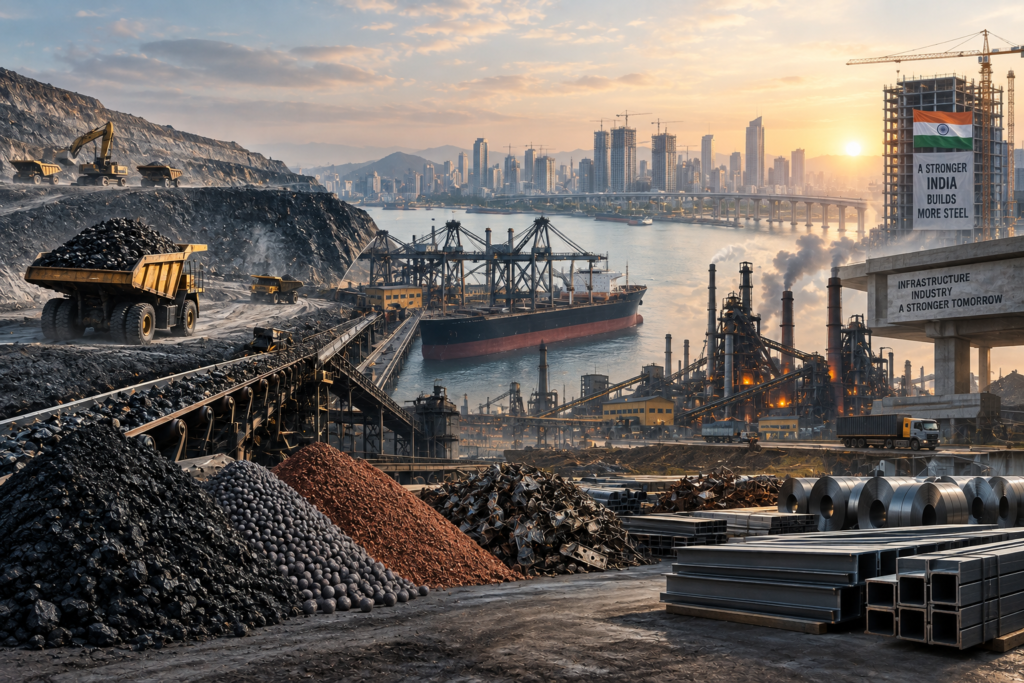
A new steel plant is easy to announce.
Capacity can be measured. Financing can be arranged. Land can be acquired. Blast furnaces, DRI units and electric arc furnaces can be engineered. Rolling mills can be installed. Production targets can be published years before the first tonne leaves the plant.
But there is a more difficult question behind every new million tonnes of steel capacity :
What will feed it?
Steel capacity does not create its own raw materials.
Every additional blast furnace requires iron-bearing burden, coke and suitable coal. Every new DRI unit increases demand for high-quality iron ore feed. Every electric arc furnace joins an increasingly competitive global search for ferrous scrap and other metallics. Every tonne of additional steel capacity creates demand somewhere upstream for mining, beneficiation, pelletisation, coking, recycling, logistics and trading.
That upstream challenge is becoming increasingly important because steel production is not growing evenly across the world.
Global crude steel production was approximately 1.85 billion tonnes in 2025. China alone produced around 961 million tonnes, while India produced approximately 165 million tonnes, making it the world’s second-largest producer. More importantly, India was one of the major markets still expanding strongly: its 2025 output increased about 10.4% year-on-year. Through January–July 2026, India produced another 101.1 million tonnes, up 6.1% from the comparable 2025 period.
That growth creates an enormous opportunity.
It also creates an equally enormous raw – material question.
Because the next chapter of global steel may not be limited by how many furnaces the industry can build.
It may be determined by how reliably those furnaces can be fed.
India’s 300-Million-Tonne Question
India provides perhaps the clearest example of the challenge.
The National Steel Policy envisages 300 million tonnes of crude steelmaking capacity by 2030 – 31, alongside approximately 255 million tonnes of crude steel production and 230 million tonnes of finished-steel production.
Put that scale into perspective.
India produced about 164.9 million tonnes of crude steel in 2025.
Reaching 255 million tonnes of production would mean adding roughly 90 million tonnes of annual output compared with 2025.
That additional production alone would be larger than the entire 2025 steel output of Japan, which produced roughly 80.7 million tonnes.
It is almost equivalent to creating another major steel – producing nation inside India.
And those extra tonnes cannot be produced by capacity alone.
They need raw materials.
- Millions of additional tonnes of coal.
- Metallurgical coke.
- Iron ore and pellets.
- Scrap.
- Pig iron and other metallic units.
- Fluxes.
- Energy.
And behind every physical tonne lies another requirement: transportation capacity.
- Railways must move it.
- Ports must handle it.
- Ships must carry imported material.
- Stockyards must store it.
- Traders must source it.
- Supply chains must finance it.
The real steel expansion story is therefore not simply about constructing furnaces.
It is about constructing an entire raw-material ecosystem around them.
Iron Ore Looks Abundant – Until Quality Enters the Conversation
At first glance, iron ore appears to be the easiest part of India’s raw – material equation.
India possesses substantial iron ore resources and is a major producer.
But steel plants do not consume “iron ore” as a generic material.
They consume specific grades, sizes and forms suited to specific processes.
A blast furnace may operate with a carefully designed mixture of sinter, pellets and lump ore. A DRI plant has different feed requirements. Emerging low – carbon steel routes increasingly favour high – grade iron ore with tighter impurity control.
That distinction becomes crucial as steel technology changes.
A tonne of ore containing 55% Fe is not operationally equivalent to a tonne containing 65% Fe.
At 55% Fe, every tonne theoretically contains around 550 kg of iron.
At 65% Fe, it contains around 650 kg.
Across one million tonnes of feed, that ten-percentage-point difference represents approximately 100,000 tonnes of additional contained iron before accounting for actual process recovery.
The remaining material does not simply disappear. Gangue components ultimately influence beneficiation requirements, slag volumes, flux demand and energy consumption.
So the future raw – material challenge is not simply :
Do we have enough ore?
It is :
Do we have enough ore of the right quality, processed into the right form, for the production routes we are building?
Pellets Could Become One of the Quiet Bottlenecks
This is where iron ore pellets become strategically important.
Pelletisation converts beneficiated iron ore fines into engineered feed with controlled size, chemistry and physical properties. High-quality pellets can improve burden consistency and, depending on the process, support better gas flow and reduction efficiency.
As steel capacity expands, pellet demand can grow for two reasons simultaneously.
The first is straightforward : more steel requires more iron units.
The second is technological.
If steelmakers increasingly move toward DRI – based production and lower – carbon pathways, demand for higher-quality iron-bearing feed can rise faster than total steel production itself.
That distinction matters.
The world may possess enormous quantities of iron ore, but not every tonne is immediately suitable for producing premium DRI – grade pellets.
- Beneficiation becomes necessary.
- Pelletising capacity becomes necessary.
- Energy becomes necessary.
- Water and infrastructure become necessary.
And suddenly the constraint is not geological availability.
It is processing capability.
The steel industry may therefore discover that having iron ore in the ground and having furnace – ready iron units available at the required time are two completely different things.
Coking Coal Is India’s More Obvious Vulnerability
If iron ore presents a quality challenge, coking coal presents a supply – security challenge.
India possesses large coal resources, but domestic availability of the high – quality, low – ash coking coal required by integrated steelmakers remains constrained. The Ministry of Steel explicitly identifies this limitation and notes sourcing from countries including Australia, the United States, Indonesia, Mozambique and Russia.
The National Steel Policy’s original objective illustrates the scale of the dependency : it sought to reduce coking-coal import dependence from roughly 85% to about 65% by 2030 – 31 through increased domestic availability and washing.
That means India’s steel expansion is connected not only to Indian mines and plants, but to mining decisions thousands of kilometres away.
An Australian cyclone can become an Indian steel problem.
A shipping disruption can become a coke – cost problem.
A currency movement can become a blast-furnace cost problem.
A change in trade policy in another country can become an Indian procurement problem.
The furnace may be located in Odisha, Jharkhand, Chhattisgarh or elsewhere in India.
But part of its raw – material security exists overseas.
Why Coking Coal Is Not Easily Replaced
The challenge becomes greater because metallurgical coal is not interchangeable with ordinary thermal coal.
Coking coal must possess specific properties that allow it to soften, become plastic and resolidify into strong metallurgical coke during carbonisation.
The coke then has to survive an extraordinarily demanding environment inside the blast furnace.
- It must provide carbon.
- It must support reduction reactions.
- It must generate heat.
And crucially, it must retain enough physical strength to preserve permeability as the burden above it softens and melts.
That dramatically narrows the pool of suitable material.
The world may have enormous coal reserves.
But the amount of premium metallurgical coal possessing the required coking characteristics is much more concentrated.
This is one of the defining features of future raw – material competition :
A resource can be globally abundant while the specific grade industry needs remains scarce.
Metallurgical Coke Adds Another Layer of Concentration
Steel producers can either manufacture coke internally or source metallurgical coke from external producers and traders.
Either way, coke availability remains connected to coking – coal supply.
Coke ovens also require substantial capital, environmental controls and long operating lives. New coke capacity cannot always be added as quickly as steelmaking capacity.
That creates an interesting imbalance.
A steel company may announce a new furnace today.
But the supporting coke ecosystem – coal contracts, coke batteries, ports, logistics and blending systems may require years of parallel development.
If steel capacity grows faster than this upstream infrastructure, competition for quality coke intensifies.
- Prices respond.
- Traders search for alternate origins.
- Plants reconsider coke rates.
- Pellet usage and burden optimization become more important.
A shortage in one material begins changing demand for another.
That interconnectedness is precisely what makes the coming raw – material challenge so complex.
Then Comes Scrap – The Material Everyone Wants More Of
If coal represents the challenge of traditional steelmaking, ferrous scrap represents one of the central challenges of steel’s lower – carbon future.
Electric Arc Furnace steelmaking relies heavily on recycled metallic units.
Globally, about 30% of crude steel production in 2025 was produced through the electric furnace route, while India had a much higher electric-furnace share of roughly 58%, according to worldsteel’s 2026 statistics.
As countries seek to reduce emissions, EAF capacity is expected to remain strategically important.
That means more plants want scrap.
And not just any scrap.
They increasingly want clean, dense, well – sorted, low – residual scrap.
This creates a fascinating paradox.
Steel is one of the world’s most recyclable materials.
In theory, scrap availability should continuously increase as yesterday’s buildings, automobiles, machinery, pipelines and infrastructure reach the end of their lives.
But scrap cannot be manufactured instantly simply because demand increases.
It must first exist as steel.
- Then that steel must remain in use for years or decades.
- Then it must reach end-of-life.
- Then it must be
- collected.
- Sorted.
- Processed.
- Transported.
And finally returned to the furnace.
Scrap supply therefore carries a built – in time lag.
You Cannot Mine Tomorrow’s Scrap Today
Consider a steel beam installed in a commercial building in 2026.
That beam may remain in service for 40, 50 or even 70 years.
It will eventually become valuable scrap.
But it cannot help feed an EAF being commissioned in 2030.
This is the fundamental difference between scrap and mined raw materials.
Mining capacity can theoretically expand when investment and reserves permit.
Scrap availability depends partly on the historical accumulation of steel within an economy.
Mature industrial economies often possess large reservoirs of steel embedded in old infrastructure, vehicles and machinery.
Fast – growing economies such as India are simultaneously consuming enormous amounts of steel to build new infrastructure.
Much of that steel will not return as scrap for decades.
So India can experience a strange situation :
Rapid steel consumption today creates abundant scrap tomorrow but not necessarily enough scrap for the furnaces being built now.
Pig Iron May Become More Strategic, Not Less
Pig iron is sometimes described as a traditional raw material in an industry moving toward newer technologies.
That interpretation misses its strategic role.
As EAF production grows and scrap quality becomes more variable, pig iron can provide relatively predictable iron units, carbon and lower residual levels compared with many scrap streams.
Suppose an EAF wants to produce a quality – sensitive grade but available scrap contains excessive residual elements.
The plant cannot simply remove all of those residuals during refining.
Instead, it can dilute them by introducing cleaner metallic units.
Pig iron can become one of those balancing materials.
So paradoxically, growth in scrap-based steelmaking does not automatically eliminate demand for primary iron units.
In some markets, it can increase their strategic importance.
The future metallic charge may increasingly be a carefully optimised mixture :
scrap for circularity,
pig iron or DRI for chemistry control,
and other metallics for flexibility.
The question shifts from “scrap or primary iron?” to :
What combination produces the required steel at the lowest total economic and carbon cost?
The Industry Is Therefore Competing for Quality, Not Just Tonnes
This is perhaps the most important shift.
The future raw – material problem is unlikely to be a simple global shortage where the world suddenly “runs out” of coal, ore or scrap.
The more realistic challenge is a shortage of the right material, in the right specification, in the right geography, at the right time and at an acceptable cost.
- There may be coal available but not enough premium coking coal.
- There may be iron ore available but insufficient high-grade feed.
- There may be pellets available but not enough material suitable for increasingly demanding reduction routes.
- There may be scrap everywhere but insufficient low-residual scrap.
There may be pig iron available but freight, energy or trade restrictions may make some origins commercially unattractive.
Raw – material availability therefore needs to be understood in five dimensions :
quantity, quality, location, timing and price.
A material is not truly “available” to a steelmaker unless all five work.
One New Steel Plant Can Change an Entire Regional Raw – Material Market
The scale of steelmaking makes this particularly important.
Imagine a new integrated facility producing 5 million tonnes of steel annually.
Depending on route, burden and operating parameters, such a plant could require several million tonnes of iron-bearing materials every year, alongside substantial quantities of coal, coke, fluxes and other inputs.
That demand does not appear gradually once production begins.
Supply contracts must be secured beforehand.
Logistics must be planned.
Port capacity may need to be reserved.
Rail infrastructure must accommodate new volumes.
Stockyards must be constructed.
Suddenly, a single project can alter the supply-demand balance for an entire region.
Multiply that across India’s planned capacity expansion and the scale becomes clear.
Steel expansion is simultaneously a mining expansion, logistics expansion, recycling expansion and trading expansion.
The Next Bottleneck May Not Be Underground at All
Perhaps the biggest misconception about future raw – material availability is assuming that geology will be the primary constraint.
Often, the material exists.
The bottleneck lies somewhere between the deposit and the furnace.
- A mine lacks rail capacity.
- A beneficiation plant cannot process enough ore.
- A pellet plant reaches capacity.
- A port becomes congested.
- A coke battery cannot expand quickly enough.
- A scrap market lacks organised collection.
- A shipping route becomes expensive.
- A stockyard cannot handle additional throughput.
This means solving the raw-material challenge requires investment far beyond mining.
The world does not merely need more resources.
It needs more usable, processed and movable resources.
The 2030 Steel Race Is Really Two Races
When the industry discusses steel expansion, attention naturally goes to new plants.
But two races are happening simultaneously.
The visible race is for steelmaking capacity.
Companies announce new furnaces, new mills and new production targets.
The invisible race is for the supply chains that will feed them.
- Coal contracts.
- Coke capacity.
- Pellet availability.
- Scrap networks.
- Pig iron.
- Beneficiation plants.
- Railways.
- Ports.
- Vessels.
- Stockyards.
The first race determines how much steel the world can produce.
The second determines how much it can produce reliably and economically.
And winning the first without preparing for the second creates expensive idle capacity.
The Future of Steel Will Be Decided Before the Furnace
India’s steel expansion represents one of the most important industrial growth stories of this decade.
But increasing production from today’s levels toward the ambitions set for 2030 – 31 will require far more than building steel plants.
It requires thinking backward from every tonne of future steel.
- Where will its iron units come from?
- Where will its metallurgical coal originate?
- Who will produce its coke?
- Will enough high – quality pellets exist?
- How much scrap will genuinely be available and of what quality?
- Where will pig iron and other metallic units fit as production routes evolve?
- How will millions of additional tonnes move through mines, railways, ports and stockyards?
These questions will increasingly separate theoretical steel capacity from sustainable steel production.
The industry is unlikely to simply run out of raw materials.
The greater risk is that demand grows faster than the industry’s ability to deliver the right raw materials, in the right form, to the right furnace, at the right time.
And that makes the next decade as much a race for raw – material intelligence and supply security as it is a race for steel capacity.