
What Months of Rain Quietly Do to Coal, Coke, Scrap, Pellets and Plant Economics?
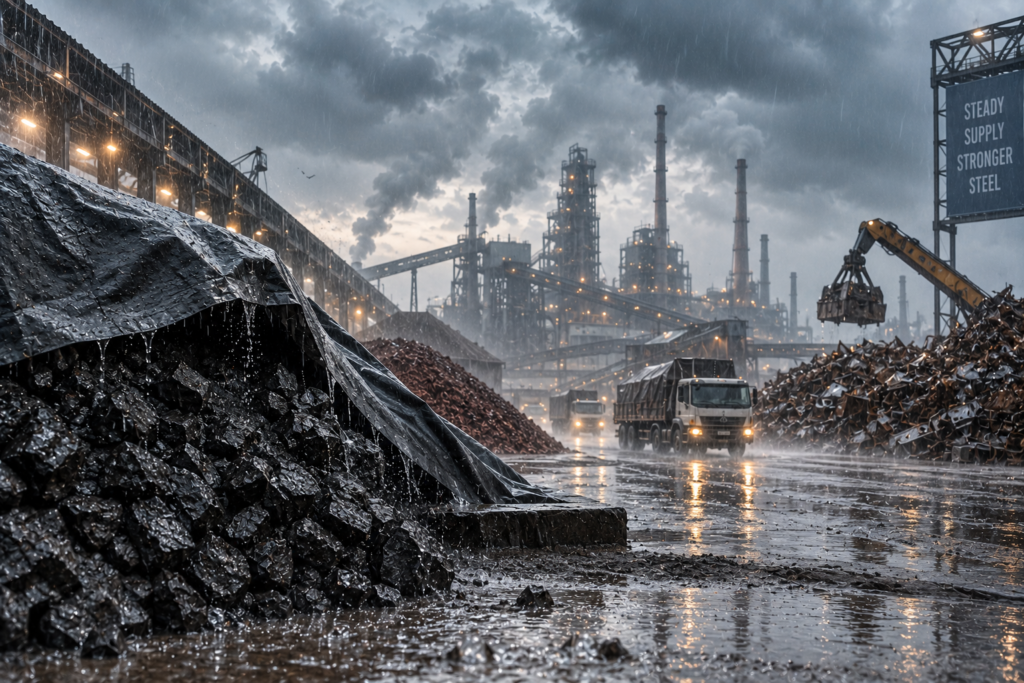
Every year, steel plants prepare for the monsoon.
Drains are cleared. Stockpiles are covered where possible. Transport schedules are reviewed. Inventory levels are adjusted. Procurement teams begin thinking differently about material that, during the dry season, may have seemed relatively straightforward to handle.
Because rain does not simply make raw materials wet. It changes their economics.
Coal absorbs additional moisture. Coke stockpiles become harder to manage. Scrap can carry water, mud and contamination into the plant. Pellets and other iron – bearing materials face handling and fines-related issues. Roads slow down. Rail movements can be disrupted. Ports lose operating hours. Stockyards become difficult to reclaim from. Trucks may carry less useful material even when the weighbridge shows the same gross tonnage.
Individually, many of these effects appear small.
Together, they create what could be called the Monsoon Tax on Steel : the additional cost, inefficiency and uncertainty that enters the raw-material supply chain during months of heavy rain.
It does not appear as a separate line on an invoice.
But the furnace eventually pays for it.
The First Tax Is Water You Never Intended to Buy
Consider a simple example.
A coal shipment normally reaches a plant at 8% total moisture. During prolonged wet conditions, effective moisture reaches 12%.
That four – percentage – point difference represents approximately 40 kg of additional water for every tonne of material.
For 10,000 tonnes, that is approximately 400 tonnes of additional water by mass.
For 100,000 tonnes, it becomes approximately 4,000 tonnes.
The precise commercial impact depends on the contractual basis for moisture, sampling procedures and material characteristics, but operationally the principle remains the same.
The plant does not need that water.
Yet it may have transported it, handled it and stored it.
Then comes the energy penalty.
Before useful combustion can occur, additional moisture must be heated and evaporated. Energy that could have contributed to the process is instead spent dealing with water.
This is why a ₹/tonne comparison between two coal supplies can become misleading during the monsoon.
The more relevant question becomes :
How much useful dry material and usable energy actually arrived?
Coal : When the Stockyard Becomes Part of the Fuel Specification
Coal is particularly exposed because large quantities are commonly stored outdoors.
During sustained rain, the surface layers of a stockpile can become significantly wetter. Fine coal tends to retain moisture differently from larger particles, and poorly drained storage areas can create pockets of very wet material.
That affects much more than GCV on an as – received basis.
Wet coal can become sticky. Chutes can experience build-up. Screens become less efficient. Crushers and conveyors may have to handle material very differently from dry – season coal. Flow through hoppers can become inconsistent.
If the material is being pulverised for an application such as PCI, additional moisture can also affect drying and grinding requirements.
The plant therefore experiences the monsoon twice.
First in the laboratory result.
Then in the handling system.
And sometimes the second cost is larger than the first.
Coke Has a Different Problem : Protecting Physical Performance
Metallurgical coke does not respond to rain exactly like coal.
Its role inside the blast furnace depends heavily on physical strength, size distribution and permeability.
Moisture itself adds unnecessary mass and handling complexity, but repeated wetting, movement and reclaiming can also interact with the broader problem of coke degradation and fines.
Coke is already subjected to several handling stages between production and furnace charging. Every transfer creates opportunities for breakage. If stockyard conditions become difficult during monsoon periods, additional movement or aggressive reclaiming can increase degradation.
The concern is not simply that the coke is wet.
The concern is what finally reaches the furnace.
A blast furnace depends on coke to help preserve void spaces through which gases travel. Excessive small particles and fines can work against that permeability.
So the real monsoon question for coke is not :
Did it get rained on?
It is :
Did storage and handling change the physical quality of the coke we are actually charging?
Scrap: Where Rain Becomes More Than an Efficiency Problem
Wet scrap creates a very different set of concerns.
Open scrap yards can collect rainwater in hollow sections, pipes, containers and folded pieces. Rust, soil and other contamination may also increase during prolonged exposure.
From an economic perspective, this lowers the amount of useful metallic material represented by every delivered tonne.
But wet scrap also requires strict operating control because water entering high – temperature molten – metal environments can create serious steam – expansion and explosion hazards.
This makes monsoon scrap management both an economic and a safety issue.
Plants may need stronger inspection, drainage and drying procedures. Scrap that appears externally dry can still trap water internally, particularly in closed or partially closed sections.
There is also the yield question.
A truckload may weigh exactly what procurement expects, but if more of that weight consists of water, mud, rust and non-metallic contamination, the furnace receives fewer useful metallic units.
Again, the weighbridge records tonnes.
The melt shop experiences quality.
Pellets: Rain Can Turn a Handling Problem Into a Furnace Problem
Iron ore pellets are engineered to provide relatively consistent physical characteristics, but what happens between production and charging still matters.
Well – produced pellets are designed to withstand transportation and handling. However, repeated transfers, abrasion and stockyard movement can generate chips and fines.
During heavy rain, those fines can become particularly troublesome.
Wet fine material can stick together, accumulate around handling equipment and alter the way material moves through screens, conveyors and bins.
If excessive fines ultimately enter the burden, they can influence permeability and gas distribution depending on the process.
The pellet may still contain the same iron.
Its physical usefulness has changed.
This is a recurring theme across monsoon raw-material management : chemistry may remain broadly acceptable while handling behaviour deteriorates.
And furnaces operate on both chemistry and physics.
The Stockyard Is Where the Monsoon Tax Compounds
During dry weather, a stockyard can appear to be little more than a storage area.
During the monsoon, it becomes part of the production system.
- Drainage suddenly matters.
- Stockpile geometry matters.
- Ground preparation matters.
- Covering strategy matters.
- The location of old and new inventory matters.
- How material is stacked and reclaimed matters.
If water accumulates around a stockpile, lower sections can behave differently from upper layers. If fine material migrates, segregation can increase. If equipment cannot access certain areas because of waterlogging or soft ground, operators may be forced to reclaim material in a sequence different from the original blending plan.
That last point is especially important.
A plant may have designed the perfect coal or ore blend on paper.
But if weather prevents the correct stockpile from being reclaimed at the correct time, the practical blend can change.
The monsoon therefore does not simply affect material quality.
It can affect the plant’s ability to control that quality.
Then the Rain Leaves the Stockyard and Enters Logistics
A raw material can be perfectly protected at origin and still encounter monsoon disruption before reaching the plant.
- Road transport slows during severe rainfall.
- Loading and unloading operations may take longer.
- Some routes become unreliable.
- Rail systems can experience weather-related disruption.
- Ports can lose operating windows during adverse conditions.
- Bulk cargo handling becomes more complicated.
- Vessel schedules can shift.
The economic consequence is inventory uncertainty.
Suppose a plant normally receives a material every seven days and maintains 15 days of stock.
That appears comfortable.
But if heavy weather delays one cargo by four days and the next logistics movement is also disrupted, the safety margin can disappear surprisingly quickly.
Plants then face an uncomfortable choice.
Reduce production.
Buy replacement material at short notice.
Use a different specification.
Or consume strategic inventory faster than planned.
This is why the monsoon tax is not only about wet material.
It is also about unreliable time.
A ₹500 Saving Can Disappear in the Rain
Imagine a procurement team identifies coal that is ₹500 per tonne cheaper.
Across 20,000 tonnes, the apparent saving is ₹1 crore.
Now imagine that during the monsoon the material arrives wetter than the alternative, requires more handling, delivers lower useful energy on an as – received basis and contributes to additional operational adjustments.
The ₹1 crore procurement saving has not necessarily disappeared.
But it must now be compared against the total consequences.
- Additional moisture.
- Extra handling.
- Potentially higher fuel consumption.
- Lower effective dry-tonnage value.
- Possible delays.
- Inventory risk.
That is the essence of the monsoon tax.
The cheapest material in June may not be the cheapest material in August.
Season changes economics.
This Is Why Seasonal Procurement Should Look Different
Good monsoon procurement begins before the rain arrives.
The objective is not simply to buy more inventory.
It is to understand which materials become vulnerable, which supply routes are most exposed and which specifications become harder to maintain during wet months.
Plants may strategically increase safety stock for critical materials before peak rainfall. Alternative suppliers can be qualified in advance rather than during an emergency. Port and inland transport exposure can be diversified where practical. Moisture clauses and sampling procedures deserve greater attention. Covered storage may be prioritised for particularly sensitive materials.
Supplier evaluation can also become seasonal.
A supplier that performs exceptionally well during dry months may struggle during the monsoon because of inadequate stockyard drainage, uncovered storage or unreliable road connectivity.
The most useful procurement history therefore does not merely say :
Supplier A delivered 98% on time.
It asks :
How did Supplier A perform when conditions were difficult?
That is a much better measure of supply reliability.
The Real Cost of Rain Is Variability
Rain itself is predictable.
The difficult part is its uneven impact.
- One coal stockpile receives far more exposure than another.
- One truck arrives almost dry while the next carries significantly wetter material.
- One pellet batch experiences minimal degradation while another contains additional wet fines.
- One scrap load is clean while another contains trapped water.
This variability forces operators to compensate.
And compensation is where costs multiply.
- Blends are adjusted.
- Fuel rates change.
- Materials require additional handling.
- Sampling frequency may increase.
- Production teams operate with larger safety margins.
- Procurement searches for replacement cargoes.
- Logistics teams reroute deliveries.
A predictable raw material allows a steel plant to optimize.
A highly variable raw material forces it to protect itself.
That difference has a price.
The Monsoon Is Really a Stress Test for the Supply Chain
Perhaps the most useful way to think about the monsoon is not as a weather event at all.
It is an annual stress test.
- It reveals whether stockyards were designed properly.
- Whether suppliers manage storage correctly.
- Whether drainage works.
- Whether inventory buffers are realistic.
- Whether transport routes are diversified.
- Whether sampling procedures detect changing moisture.
- Whether procurement and operations communicate quickly enough.
During dry weather, weak systems can remain invisible.
Rain exposes them.
And that makes monsoon performance an important benchmark for suppliers, traders and steel plants alike.
Rain Is Free. Handling Its Consequences Isn’t.
The monsoon never appears on a steel plant’s raw – material invoice.
But its fingerprints can be found everywhere.
- In additional moisture carried with coal.
- In difficult coke handling.
- In wet scrap that requires greater inspection and control.
- In pellet fines that become harder to manage.
- In waterlogged stockyards.
- In delayed trucks and trains.
- In disrupted port schedules.
- In emergency procurement.
And ultimately, in the additional variability the furnace has to absorb.
For steel plants, the smartest response is not to treat monsoon disruption as an unavoidable seasonal inconvenience.
It is to treat weather as another raw-material variable – one that can be planned for, measured and managed.
Because During the Monsoon, You Aren’t Just Buying Coal, Coke, Scrap or Pellets.
You may also be buying water, delays and uncertainty and the most prepared plants are the ones that pay the least for all three.