
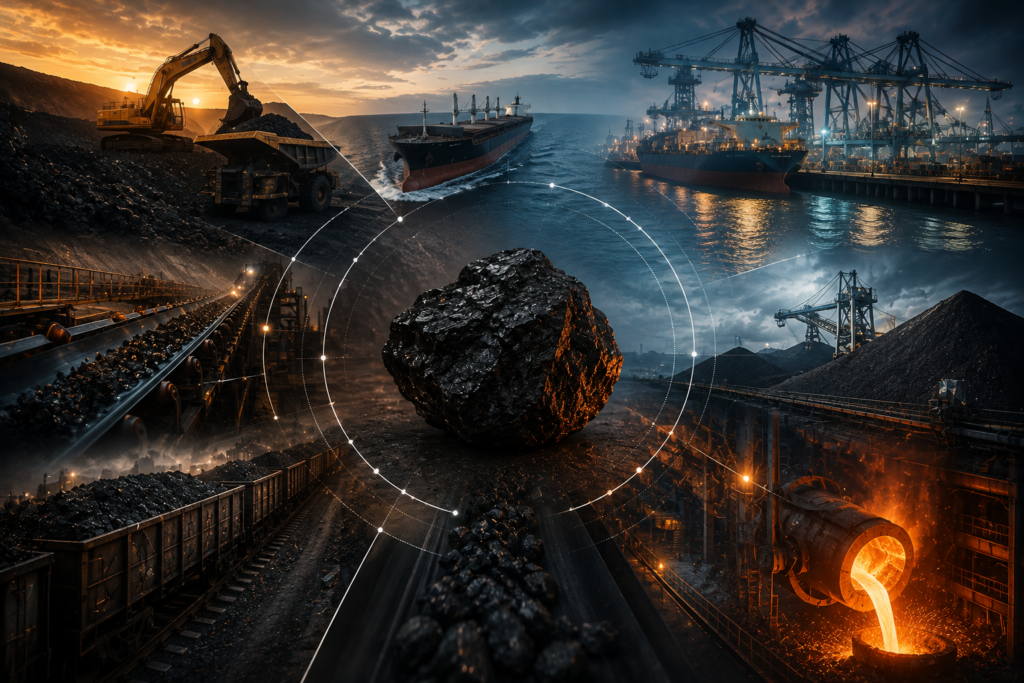
From a South African Mine to an Indian Blast Furnace – The Remarkable Journey Behind a Material We Usually Measure Only by the Tonne
By the time one tonne of imported coal reaches an Indian steel plant, it has already lived a surprisingly complicated life.
It may have been blasted out of rock hundreds of metres from where it eventually boarded a ship. It may have travelled by haul truck, conveyor, rail and bulk carrier. It may have been crushed, screened, sampled, blended, stored, reclaimed and tested multiple times. It may have crossed more than 7,000 kilometres of ocean, spent weeks exposed to changing temperatures and humidity, passed through several commercial hands and accumulated freight, insurance, handling and financing costs along the way.
And after all of that, its most important journey lasts only a matter of hours.
It enters the steelmaking system.
- To a procurement team, it is one tonne on a purchase contract.
- To a trader, it is part of a cargo.
- To a laboratory, it is a combination of calorific value, ash, moisture, volatile matter, sulphur and fixed carbon.
- To a steel plant, however, it is something else entirely.
It is energy, carbon, chemistry, cost and operational risk packed into one tonne of black material.
So what actually happens between the moment coal leaves the ground in South Africa and the moment its carbon contributes to ironmaking in India?
To understand that, we have to follow the tonne itself.
6:10 AM – Somewhere in South Africa, Our Tonne Doesn’t Exist Yet
Our tonne begins as part of a coal seam buried beneath layers of rock.
It has been waiting there considerably longer than the steel plant waiting for its shipment.
Coal deposits formed from organic matter accumulated millions of years ago. Over geological time, heat and pressure transformed that material, progressively concentrating carbon and changing its physical and chemical properties.
That geological history still matters today.
Coal is not a uniform black fuel.
Its rank, maceral composition, mineral matter, volatile content, sulphur, moisture, ash behaviour and in the case of coking coal – plasticity and coking characteristics are strongly influenced by how and where it formed.
This is why “South African coal” is not one specification.
Different mines and seams can produce significantly different materials. South Africa is particularly important in international thermal coal markets, while selected coal streams may also find specialised industrial and metallurgical applications depending on their characteristics.
Before the material is extracted, drilling and geological modelling have already attempted to predict what lies beneath the surface.
The first lesson in our tonne’s journey is therefore unexpected:
Its performance was being determined millions of years before anybody negotiated its price.
7:30 AM – The First Transformation Is Violent
Mining begins.
Depending on the deposit and mine configuration, coal may be extracted through surface or underground operations. In large surface mines, overburden is removed and controlled blasting may break the coal-bearing formation so excavators and loaders can recover the material efficiently.
Our theoretical tonne is no longer part of a geological seam.
It is now fragmented material.
And immediately, variability begins.
Coal extracted from different sections of a seam may contain different levels of mineral matter. Dilution from surrounding rock can increase ash. Particle sizes vary dramatically after extraction.
At this stage, one tonne is not yet the carefully specified product an Indian buyer expects.
It is raw coal.
The mine has extracted it.
Now the supply chain must manufacture consistency out of geological variability.
9:15 AM – The Tonne Goes Through Its First Quality Test
Raw coal is transported toward processing facilities.
This stage is crucial because the material emerging from the mine may contain unwanted rock and mineral matter.
Depending on the product specification, coal preparation can involve crushing, screening and washing.
Coal washing exploits differences between coal and denser mineral impurities. Through processes such as dense-medium separation, unwanted mineral matter can be reduced.
Why does that matter?
Because ash does not contribute useful combustion energy.
If a coal contains 15% ash, approximately 150 kg of every tonne represents non-combustible mineral matter.
At 10% ash, that figure falls to around 100 kg.
That 50 kg difference may appear insignificant until a plant consumes hundreds of thousands of tonnes.
Across 100,000 tonnes, five percentage points represent approximately 5,000 tonnes of additional ash-bearing material entering the system.
The plant must heat it.
Handle it.
And ultimately deal with the resulting mineral load.
Our tonne is therefore being prepared not simply to meet a commercial specification, but to reduce the burden it will eventually place on the furnace.
11:40 AM – Our Tonne Loses Its Identity
This is one of the most interesting moments in the journey.
The tonne we are following effectively disappears.
Not physically.
Statistically.
It is blended with thousands of other tonnes.
Coal from different sections of the mine may be combined to achieve a more consistent product. Stockpiles are deliberately built and reclaimed to reduce variations in characteristics such as ash, moisture, sulphur and calorific value.
This is where industrial coal trading becomes very different from buying a manufactured component.
A bolt can be manufactured repeatedly to almost identical dimensions.
Coal begins as a naturally variable geological material.
The challenge is therefore not eliminating variability completely.
It is controlling it.
Our tonne is now part of something much larger : a commercial parcel engineered to behave within an agreed operating range.
Day 2 – The Laboratory Gives Our Tonne a Numerical Identity
Before export, samples are collected and analysed.
Suddenly, the tonne that began as a piece of geological history becomes a collection of numbers.
Perhaps the analysis shows a gross calorific value somewhere around 5,500 – 6,500 kcal/kg, depending on the coal product being supplied.
- Ash is measured.
- Total moisture is recorded.
- Volatile matter is analysed.
- Sulphur is checked.
Fixed carbon is calculated or determined according to the applicable method.
For specialised metallurgical applications, additional parameters may become important.
These numbers determine commercial value.
A difference of a few percentage points in ash or moisture can influence pricing significantly.
But laboratory analysis also introduces an important reality.
The sample is not the entire cargo.
A shipment may contain tens of thousands of tonnes.
Quality assurance therefore depends heavily on representative sampling.
If the sample does not accurately represent the cargo, even perfect laboratory testing can provide an imperfect picture.
The journey from geology to data depends on statistics.
Day 3 – Coal Meets the Railway
Our tonne now begins moving toward the coast.
South Africa’s coal export system depends heavily on large-scale inland logistics connecting mining regions with export terminals, particularly the major coal corridor toward Richards Bay.
Rail transport is extraordinarily important because bulk commodities operate on an enormous scale.
A typical export cargo may contain tens of thousands of tonnes, and large bulk vessels can carry considerably more.
Moving that quantity by road alone would require thousands of truck movements.
Rail provides the scale necessary to connect inland production with maritime trade.
Our tonne is loaded into a train with thousands of others.
For perhaps the first time, the economics of the material are now influenced more by logistics than geology.
The coal itself has stopped changing dramatically.
Its cost has not.
Day 4 – A Logistics Delay Changes Everything Without Changing the Coal
Imagine the train is delayed.
- Perhaps infrastructure congestion develops.
- Perhaps maintenance interrupts movement.
- Perhaps weather slows operations.
Nothing has happened to the coal’s original specification.
- Yet its economics have changed.
- Inventory remains tied up.
- Port schedules may be affected.
- A vessel may eventually have to wait.
- Demurrage exposure can increase.
- Customer delivery dates may move.
This is the strange economics of commodity trading.
A tonne can become more expensive while sitting completely still.
By the time our coal reaches India, logistics may have influenced its commercial value almost as much as its chemical characteristics.
Day 6 – The Ocean Is Finally Visible
Eventually, our tonne reached the export terminal.
Here, coal moves through one of the most impressive pieces of infrastructure in the commodity world.
Rail wagons are unloaded.
Coal enters conveyor systems.
It may pass through stockyard operations.
Stackers build enormous piles.
Reclaimers later recover the material.
Conveyors carry it toward ship loaders.
Each handling stage matters.
Every transfer can create some degradation and additional fines.
Every period of outdoor storage introduces weather exposure.
Rain can increase surface moisture.
Wind can create dust losses.
Repeated handling changes particle – size distribution.
The laboratory certificate remains the same document.
The physical cargo continues evolving.
Day 8 – Our Tonne Becomes 1/80,000th of a Ship
A large dry bulk carrier arrives.
Suppose the vessel loads approximately 80,000 tonnes of coal.
Our tonne now represents just 0.00125% of the cargo.
It disappears into a cavernous ship held alongside tens of thousands of tonnes of similar material.
The vessel itself becomes part of the economics.
- Its charter rate matters.
- Marine fuel prices matter.
- Insurance matters.
- Port charges matter.
- The chosen route matters.
Even the speed at which the vessel sails can influence cost.
The price originally negotiated at the mine is no longer the number that matters most.
The buyer ultimately cares about the landed cost.
And the landing cost is still changing.
Day 9 – The Voyage to India Begins
The bulk carrier leaves the South African coast and enters the Indian Ocean.
Depending on origin port, destination, route and operating conditions, the voyage to India’s western or eastern coast can cover roughly 6,000 – 8,000 kilometres or more.
At an average bulk – carrier operating speed of roughly 12 – 14 knots, the sea journey itself can take around two weeks, sometimes longer once weather, routing and port waiting times are considered.
For the steel plant, these are not merely kilometres.
They are inventory days.
The coal has already been paid for or financed under agreed commercial terms.
But it cannot yet produce anything.
Capital is literally floating across the ocean.
Day 14 – The Coal Is Changing While Nobody Is Touching It
The cargo looks inactive inside the hold.
Chemically, however, coal is not perfectly static.
Coal can oxidise when exposed to oxygen. The rate depends on rank, particle size, temperature and storage conditions.
Freshly exposed surfaces are generally more reactive.
Finer particles provide greater surface area.
Over extended periods, oxidation can gradually influence coal characteristics and reduce useful energy.
Moisture can also redistribute within a cargo.
The exact changes during a normal sea voyage vary considerably, and a well – managed shipment should not be imagined as deteriorating dramatically over a few days.
The broader point is important :
The specification measured at origin is a snapshot, not a guarantee that every physical property remains frozen forever.
Time is now part of quality.
Day 19 – Somewhere in India, Someone Is Watching a Screen
While our tonne crosses the Indian Ocean, the procurement and trading teams are not waiting passively.
They are tracking the vessel.
- Estimated time of arrival is monitored.
- Port conditions are reviewed.
- Inventory at the plant is calculated.
- Future consumption is forecast.
- Trucks or rail logistics may be arranged.
Documentation moves between sellers, buyers, banks, insurers, surveyors, customs agents and port authorities.
This reveals an overlooked aspect of raw material trading.
Moving coal is partly a physical business.
It is also an information business.
The cargo is at sea.
But dozens of commercial decisions are already being made around it.
Day 22 – India Appears on the Horizon
The vessel approaches an Indian port.
Our tonne has travelled thousands of kilometres.
But it still has not reached the plant.
First comes berthing.
If a berth is available, unloading can begin according to terminal arrangements.
If not, the vessel may wait at anchorage.
Every additional waiting day matters.
Depending on the charter arrangement, delays beyond agreed laytime can create demurrage.
A delay at this stage can therefore increase the landed cost of coal without altering a single chemical property.
Again, the material stays the same.
The economics do not.
Day 24 – The Tonne Touches India
Unloading begins.
Grab cranes or specialised bulk-handling systems remove coal from the vessel.
It passes into hoppers, conveyors or storage areas depending on port infrastructure.
Samples may again be collected.
Quality may be checked against contractual specifications.
Quantity is reconciled.
Moisture differences can become commercially important because the buyer wants coal, not water.
If moisture is one percentage point higher than expected, that represents approximately 10 kg additional water per tonne.
Across an 80,000 – tonne cargo, one percentage point corresponds to around 800 tonnes of mass.
That is why apparently small percentages receive enormous attention in bulk commodity contracts.
Scale magnifies everything.
Day 25 – Customs Clears the Cargo, But the Journey Continues
Documentation is completed.
Duties and applicable charges are accounted for.
Port handling costs accumulate.
The coal is now legally and commercially ready to move inland.
But the steel plant may still be hundreds of kilometres away.
Depending on the location, coal may travel by rail, road or a combination of transport modes.
Each transfer adds cost.
Each handling step introduces the possibility of loss, contamination or particle degradation.
At this stage, our tonne has already been handled multiple times since leaving the mine.
- Mine.
- Processing plant.
- Stockpile.
- Rail.
- Export terminal.
- Ship.
- Indian port.
- Inland logistics.
The apparently simple act of buying coal is actually a chain of industrial coordination stretching across two countries and an ocean.
Day 27 – Our Tonne Finally Reaches the Steel Plant
The truck or rail wagon enters the plant.
For procurement, the journey is nearly complete.
For operations, it is just beginning.
The coal may be sampled again.
It may enter a stockyard.
It may be blended with coal from other origins.
Depending on its intended application, it may be crushed or prepared further before use.
If it is part of a metallurgical coal blend for coke production, its next destination may be a coke oven rather than the blast furnace directly.
If it is suitable PCI coal, it may eventually be pulverised and injected into the blast furnace through the tuyeres.
Different coals therefore take different final paths.
And this distinction is critical.
Metallurgical coal is not simply thrown into a blast furnace as generic fuel.
Its role depends on its characteristics and the steelmaking process it was purchased to serve.
Day 30 – If It Is Coking Coal, Fire Changes Everything
Suppose our tonne forms part of a coking coal blend.
It is crushed and blended with other suitable coals before entering a coke oven battery.
Inside the oven, the coal is heated to roughly 1,000 – 1,100°C in the absence of oxygen.
It does not simply burn.
It carbonises.
Volatile components are driven off.
The coal softens, becomes plastic and eventually resolidifies into a strong, porous carbon-rich material.
Coke.
A tonne of dry coal does not become a tonne of coke.
Typical coke yields can broadly fall around 70 – 80% of the dry coal charge, depending on coal blend and operating conditions.
So our original tonne has now physically transformed.
Part of its mass leaves as coke-oven gas and other by-products.
What remains becomes one of the most important structural materials inside the blast furnace.
Day 31 – The Material That Began Underground Returns to Darkness
The coke is screened and transported toward the blast furnace.
Its requirements have changed completely.
As coal, parameters such as volatile matter and coking properties mattered.
As coke, strength and reactivity become critical.
The blast furnace needs coke to survive crushing loads, high temperatures and chemical attack while maintaining permeability.
Our tonne’s story is no longer about calorific value alone.
It is about structure.
The Final Hours – Inside the Blast Furnace
The coke enters from the top of the blast furnace alongside iron – bearing materials such as sinter, pellets and lump ore, depending on burden design.
Hot blast air enters near the bottom through tuyeres.
Temperatures in the raceway region can exceed 2,000°C.
Carbon reacts with oxygen.
Heat is released.
Carbon monoxide forms and travels upward through the burden.
That gas becomes a powerful reducing agent.
Iron oxides progressively lose oxygen.
Fe₂O₃ moves through intermediate oxide stages toward metallic iron.
The iron softens.
Then it melts.
It moves downward.
Carbon dissolves into it.
Slag separates unwanted mineral matter.
The material that began as ancient organic matter beneath South African ground is now participating directly in the chemistry that produces hot metal.
Its physical identity disappears.
Its carbon does not.
Part becomes carbon dissolved in hot metal.
Part leaves as carbon monoxide or carbon dioxide in furnace gas.
Part contributes thermal energy.
The tonne of coal is gone.
Its work is complete.
But What Did That One Tonne Really Carry?
At the beginning, it looked like a commodity.
By the end of its journey, it becomes clear that it carried much more.
- It carried geological history from a South African coal seam.
- It carried the decisions of miners and processing engineers.
- It carried quality control from laboratories.
- It carried rail capacity.
- It carried port infrastructure.
- It carried dry-bulk freight economics.
- It carried marine fuel and insurance exposure.
- It carried currency risk.
- It carried weeks of working capital.
- It carried logistics coordination in India.
And finally, it carried energy and carbon into one of the world’s most demanding industrial processes.
The furnace sees only the final material.
But embedded inside that material is an entire global supply chain.
The Economics of the Journey
This is why the original mine price tells only part of the story.
Imagine, purely illustratively, that coal is purchased at US$120 per tonne FOB.
Ocean freight adds US$20.
Insurance and finance contribute additional costs.
Port handling and inland logistics add further expenses.
By the time the tonne reaches the plant, the effective delivered cost may be dramatically different from the price at origin.
If freight rises from US$20 to US$35 per tonne, the coal has not changed.
If the currency weakens 5%, the coal has not changed.
If port delays add demurrage, the coal has not changed.
Yet the economics of using it have.
That is why modern raw material trading cannot be reduced to buying and selling a commodity.
It is the management of dozens of variables surrounding that commodity.
One Tonne Is Small. Scale Changes Everything.
One tonne is easy to imagine.
A steel plant does not consume one tonne.
Large integrated steel operations can consume millions of tonnes of coal and coke-related inputs annually.
At one million tonnes, a US$1 per tonne difference equals US$1 million.
A one-percentage-point moisture difference represents 10,000 tonnes of mass.
A small improvement in fuel rate, multiplied across annual hot-metal production, can have enormous financial consequences.
This is why experienced procurement teams obsess over numbers that outsiders might dismiss as insignificant.
In bulk commodities, decimals become crores.
There Is No Such Thing as “Just a Tonne of Coal”
When a truck unloads coal at a steel plant, the material appears ordinary.
- Black.
- Dusty.
- Industrial.
Nothing about it reveals the extraordinary journey behind it.
- You cannot see the South African mine.
- You cannot see the processing plant.
- You cannot see the train.
- You cannot see the export terminal.
- You cannot see the thousands of kilometres of ocean.
- You cannot see the vessel charter, insurance contract, currency exposure, port operations or laboratory reports.
But all of them are there, in the economics, quality and performance of that tonne.
And this is perhaps the most important lesson from following its journey.
Steelmaking does not begin at the blast furnace.
It begins thousands of kilometres away, with decisions made by miners, processors, traders, logistics teams and procurement professionals long before the furnace ever sees the material.
By the time one tonne of coal finally enters the steelmaking process, the furnace is simply writing the last chapter of a story that began millions of years ago.
From Mine to Metal : How Far Does One Tonne Really Travel?
Thousands of kilometres, dozens of decisions, multiple transformations and millions of years of geological history – all for a final journey through the furnace that may last only hours.