
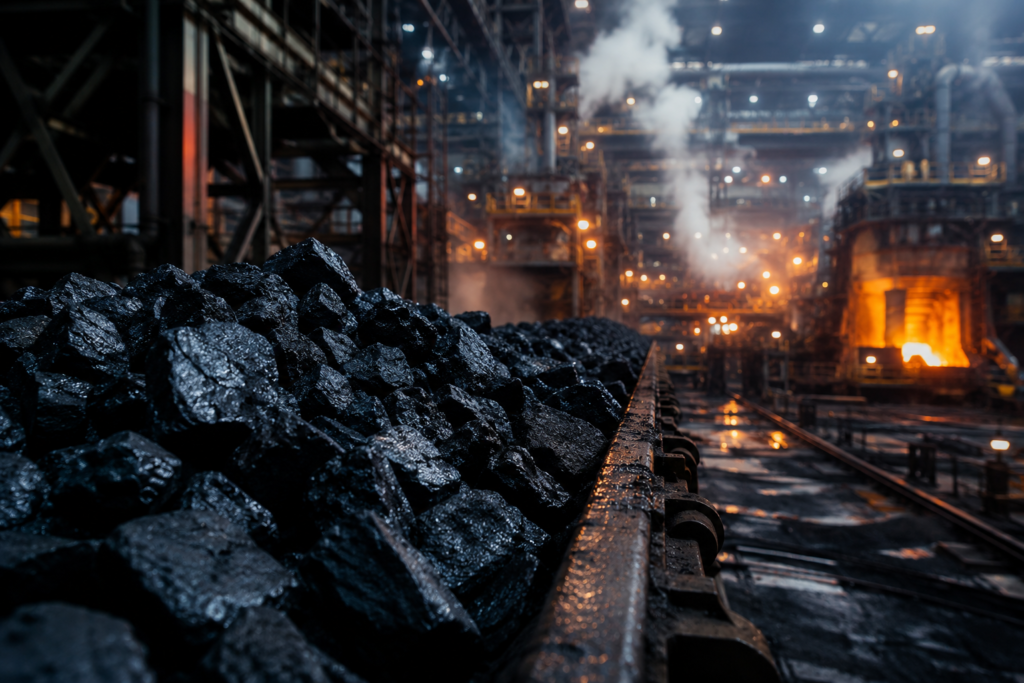
Modern steel plants are often described as engineering marvels.
They operate continuously.
Thousands of tonnes of material move every day.
Furnaces run at temperatures exceeding 1,500°C.
Production schedules are planned weeks in advance.
Inventory is carefully managed.
Supply chains stretch across continents.
Yet beneath this impressive machinery lies a surprising reality :
A steel plant is only as strong as its weakest raw material supply.
Many people assume production stops only when there is a major equipment failure.
- A furnace breakdown.
- A power outage.
- A mechanical accident.
In reality, some of the most expensive disruptions begin much earlier.
- A delayed coal vessel.
- A shortage of pellets.
- A missed coke shipment.
- An unexpected scrap supply gap.
One missing raw material can trigger a chain reaction that spreads through the entire operation.
And because steelmaking is an interconnected process, the impact grows larger with every passing day.
This is the story of a hypothetical but very realistic, seven – day raw material crisis.
Day 0 : Everything Looks Normal
The plant is operating smoothly.
Inventory levels appear comfortable.
Production targets are being met.
Management reviews show :
- Coal inventory : 18 days
- Coke inventory : 12 days
- Pellet inventory : 15 days
- Scrap inventory : 10 days
Nothing appears alarming.
Then procurement receives an update.
A key raw material shipment has been delayed.
Estimated delay :
7 days.
At first, nobody panics.
After all, there is inventory available.
The crisis has technically not started.
But the countdown has.
Day 1 : Procurement Enters Emergency Mode
The first response is not operational.
It is commercial.
The procurement team begins assessing options.
Questions immediately emerge :
- Can alternate suppliers deliver?
- Are spot market volumes available?
- What are current freight rates?
- Can inventory be stretched?
Suddenly, a shipment delay becomes a financial problem.
Typical Emergency Procurement Consequences
- Higher spot market prices
- Faster freight premiums
- Reduced supplier negotiating power
- Lower quality alternatives entering consideration
Materials that were rejected last week suddenly become “possible options.”
The plant hasn’t lost production yet.
But costs have already started rising.
Day 2 : Inventory Planning Starts Changing
Operations and procurement begin revising consumption rates.
The focus shifts from optimization to survival.
Instead of maximizing productivity, management asks :
“How do we make our inventory last?”
This subtle shift changes everything.
Common Responses
Coal Shortage
- Reduce injection rates
- Adjust burden mix
Pellet Shortage
- Increase alternative burden materials
Scrap Shortage
- Increase pig iron usage
Coke Shortage
- Modify charging patterns
Every adjustment creates secondary consequences.
The process is no longer running under ideal conditions.
Day 3 : Furnace Efficiency Begins to Decline
The first operational symptoms emerge.
Not dramatic.
But measurable.
Typical Indicators
- Higher fuel consumption
- Increased process variability
- Lower productivity
- More operator interventions
A blast furnace designed around a specific burden mix suddenly operates with substitutes.
A DRI kiln receives materials outside its preferred range.
An EAF works with different metallic proportions.
The plant remains operational.
But efficiency starts slipping.
The Hidden Cost of Day 3
Many disruptions become expensive before production actually falls.
Example :
A 2% productivity decline at a plant producing :
5,000 tonnes/day
Equals :
100 tonnes/day lost output.
At ₹45,000 – ₹55,000 per tonne steel value :
The losses become significant almost immediately.
Day 4 : The Domino Effect Accelerates
The shortage begins affecting multiple departments.
What started as a procurement issue is now an operational issue.
Production Team
Struggling to maintain targets.
Quality Team
Monitoring increased variability.
Maintenance Team
Observing higher stress on equipment.
Commercial Team
Managing delayed commitments.
Procurement Team
Still trying to secure replacement material.
At this stage, the plant enters reactive mode.
Decisions become short-term.
Day 5 : Quality Risks Start Appearing
Raw material substitutions rarely affect only productivity.
Quality often follows.
Example : Coal Replacement
Different ash characteristics may alter :
- Slag chemistry
- Heat balance
- Process stability
Example : Scrap Replacement
Variable chemistry can create :
- Residual element issues
- Increased alloy correction
- Product consistency challenges
Example : Pellet Replacement
Different reducibility may affect :
- Metallization
- Yield
- Energy consumption
The furnace continues running.
But output quality becomes harder to predict.
Day 6 : Costs Become Visible
Until now, most impacts were hidden.
Now they start appearing in reports.
Typical Cost Increases
Emergency Freight
+20 – 50%
Spot Material Purchases
+5 – 15%
Additional Fuel Consumption
+2 – 5%
Yield Reduction
1 – 3%
Overtime & Logistics Costs
Additional unplanned expenses
What initially seemed like a manageable delay begins showing measurable financial consequences.
Day 7 : Production Targets Are Officially Revised
At this stage, management often faces difficult decisions.
Option 1
Continue production with compromised efficiency.
Option 2
Reduce production rates.
Option 3
Temporarily idle certain operations.
None are ideal.
The original shipment delay has now evolved into a plant-wide challenge.
The Numbers Behind a 7 – Day Crisis
Consider a mid-sized steel operation.
Annual capacity :
1 million tonnes
Daily production:
~2,740 tonnes
If a raw material disruption causes :
5% Productivity Loss
Daily output reduction :
137 tonnes
Over 7 days :
959 tonnes
At ₹50,000 per tonne steel value :
Potential production impact :
₹4.8 crore+
And this excludes :
- Emergency procurement
- Additional fuel
- Freight premiums
- Quality-related costs
The real cost can be substantially higher.
Why Some Raw Materials Create Bigger Crises Than Others
Not all shortages are equal.
Coal
Impacts energy availability and heat balance.
Metallurgical Coke
Impacts furnace structure and permeability.
Pellets
Impacts reduction efficiency.
Scrap
Impacts metallic charge flexibility.
Pig Iron
Impacts melt stability and chemistry control.
The severity depends on :
- Inventory coverage
- Alternate sourcing options
- Furnace design flexibility
Why Modern Steel Plants Are More Vulnerable Than Ever
Today’s supply chains are leaner.
Many operations prioritize :
- Lower inventory
- Working capital efficiency
- Just-in-time procurement
These strategies improve financial performance. Until disruption arrives.
A decade ago, many facilities maintained :
60 – 90 days inventory.
Today :
30 – 45 days is increasingly common.
Some operations maintain even less.
The margin for error has narrowed.
The Strategic Value of Supply Chain Resilience
Leading producers increasingly focus on :
Diversified Sourcing
Avoid dependence on one region.
Inventory Intelligence
Balance cost with security.
Supplier Reliability
Consistency over lowest price.
Raw Material Flexibility
Ability to adjust burden mix safely.
The Lesson Most Plants Learn Too Late
A raw material is often viewed as a commodity.
Something that can simply be replaced if necessary.
Reality is more complicated.
Every furnace is designed around specific inputs.
Every process depends on predictable supply.
Every tonne of steel begins long before production starts.
It begins with raw material availability.
Beyond Day Seven : The Real Damage Is Often Long – Term
Even after supply is restored :
- Production schedules remain affected
- Procurement costs stay elevated
- Inventory buffers need rebuilding
- Customer commitments require recovery
The disruption may last seven days.
The consequences can last months.
Steel Plants Don’t Run on Equipment Alone
Blast furnaces.
DRI kilns.
Electric arc furnaces.
Rolling mills.
They are the visible parts of steelmaking.
The invisible foundation is raw material supply.
When that foundation weakens, every department feels the impact.
And often, the most expensive day in a steel plant isn’t the day a furnace stops.
It’s the day a critical raw material fails to arrive.
The Real Question Isn’t Whether a Supply Disruption Will Happen.
It’s whether the plant can survive seven days of uncertainty without turning a logistics problem into an operational crisis.