
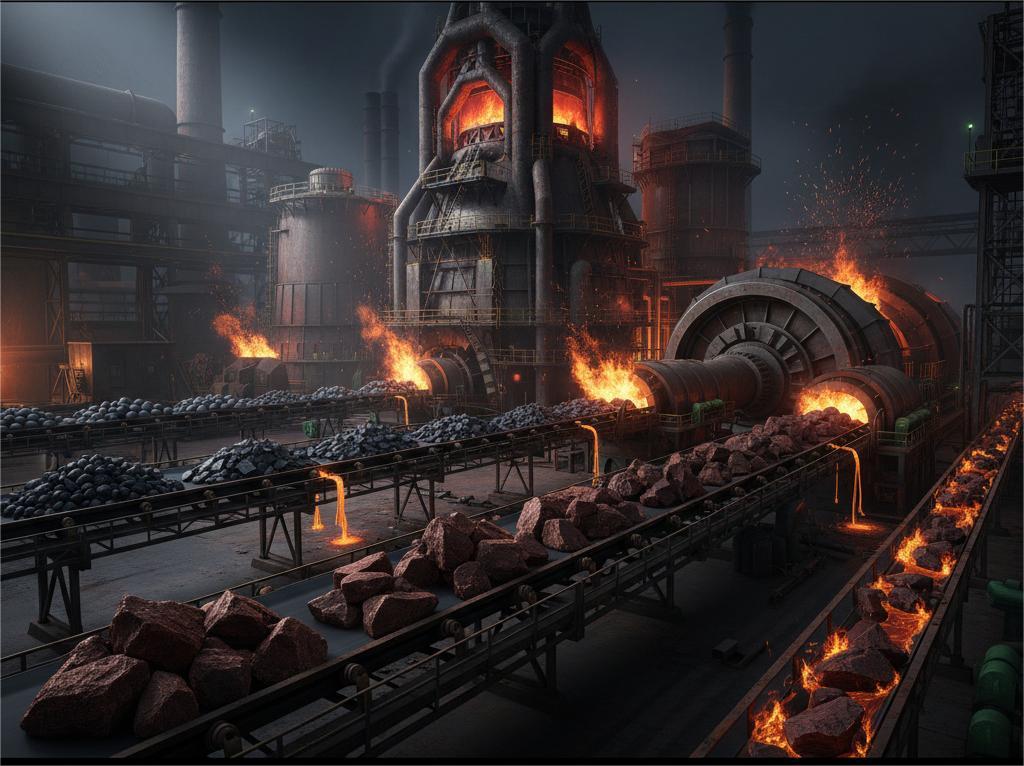
In ironmaking, the raw material decision is often simplified into a checklist : availability, landed cost, and size specification. Yet inside the blast furnace or DRI kiln, the choice between pellets, sinter, and lump ore quietly dictates productivity, fuel consumption, emissions, and maintenance cycles.
All three deliver iron.
But they do so at very different economic and operational costs.
The real question is not which is cheaper per tonne – it is which delivers the lowest cost per tonne of hot metal or sponge iron produced.
Understanding the Three Inputs
Before economics, it’s important to understand what each input actually brings into the furnace.
1. Iron Ore Lump
- Natural mined ore
- Size : 6 – 30 mm
- Fe content : 60 – 65%
- Minimal processing
- Highly dependent on mine quality
2. Sinter
- Agglomerated fines fused at high temperature
- Size : 10 – 50 mm
- Fe content : 55 – 60%
- Requires sinter plant infrastructure
- Higher gangue content
3. Pellets
- Spherical agglomerates made from beneficiated fines
- Size : 8 – 16 mm
- Fe content : 63 – 67%
- Uniform chemistry and size
- Highest processing intensity
Cost on Paper vs Cost in the Furnace
Typical Landed Cost ( Indicative, Relative )
- Lump : Lowest upfront
- Sinter : Mid – range
- Pellets : Highest upfront
However, landed cost alone ignores :
- Fuel efficiency
- Productivity rates
- Yield losses
- Maintenance costs
- Emissions penalties
The furnace does not care what you paid per tonne, it reacts to how consistently and efficiently iron is reduced.
Productivity Impact : Where Pellets Start Winning
Pellets are engineered for uniform porosity and chemistry, which improves gas flow and reduction kinetics.
Observed operational impact :
- Pellets can improve productivity by 8 – 15%
- Higher metallization rates in DRI kilns
- More stable burden descent in blast furnaces
Lump ore, while cheaper, often :
- Breaks during handling
- Creates fines inside the furnace
- Disrupts permeability
Sinter performs better than lump but still carries :
- Higher gangue
- Higher coke requirement
Fuel Consumption : The Hidden Giant
Fuel accounts for 35 – 45% of ironmaking cost.
Typical Coke / Coal Consumption (per tonne of hot metal) :
- Lump-heavy burden : +30-50 kg
- Sinter-heavy burden : Baseline
- Pellet-heavy burden : –25 to –40 kg
Why pellets reduce fuel :
- Higher Fe means less gangue to melt
- Better reducibility
- Higher thermal efficiency
Even a 5% fuel reduction can translate into ₹1,500 – ₹2,500 savings per tonne of output at current energy prices.
Maintenance & Downtime Economics
Lump Ore
- Variable size → uneven burden
- Higher refractory wear
- More frequent scaffolding and slips
Sinter
- Higher alkali and silica content
- Increases slag volume
- Higher erosion in lower furnace zones
Pellets
- Uniform size and chemistry
- Lower slag volume
- Extended refractory life by 10 – 20%
One unplanned shutdown can erase the cost advantage of cheaper raw material in a single event.
Yield & Metal Recovery
Metal Yield Impact
- Pellets typically improve yield by 1 – 2%
- Fewer fines loss
- More predictable tapping cycles
At a plant producing 1 million tonnes annually, a 1% yield improvement equals :
- 10,000 tonnes of additional output
- Without adding capacity
That alone can justify higher pellet costs.
Environmental & Compliance Costs
Environmental norms are no longer optional line items.
Emission Differences
- Pellets generate lower dust
- Reduced slag → lower disposal cost
- Lower fuel → reduced CO₂ per tonne
Many plants report :
- 5 – 10% lower CO₂ intensity with higher pellet usage
- Easier compliance with tightening emission norms
As carbon accounting becomes stricter, this advantage compounds.
Sinter’s Strategic Role ( Still Relevant )
Despite its downsides, sinter remains important :
- Enables recycling of plant fines
- Reduces dependency on external pellet suppliers
- Flexible chemistry adjustment
However, sinter-heavy operations face :
- High capital and operating cost
- Higher emissions
- Rising regulatory pressure
The Blended Reality
Most successful operations do not choose one. They optimize the mix.
Common Industrial Blends
- Blast Furnace : 50 – 70% sinter + 20 – 40% pellets + limited lump
- DRI Kilns : High pellet + calibrated lump
- Cost-sensitive operations : Pellets during high output cycles, lump during low demand
Smart plants treat raw materials like a portfolio, not a purchase order.
The Real Economic Question
The real decision is not : “Which is cheapest today?”
It is :
“Which input lowers my cost per tonne of iron over 12 months?”
When productivity, fuel, yield, maintenance, and compliance are accounted for :
- Pellets often deliver the lowest total cost
- Sinter provides flexibility
- Lump works best as a controlled supplement, not a base