
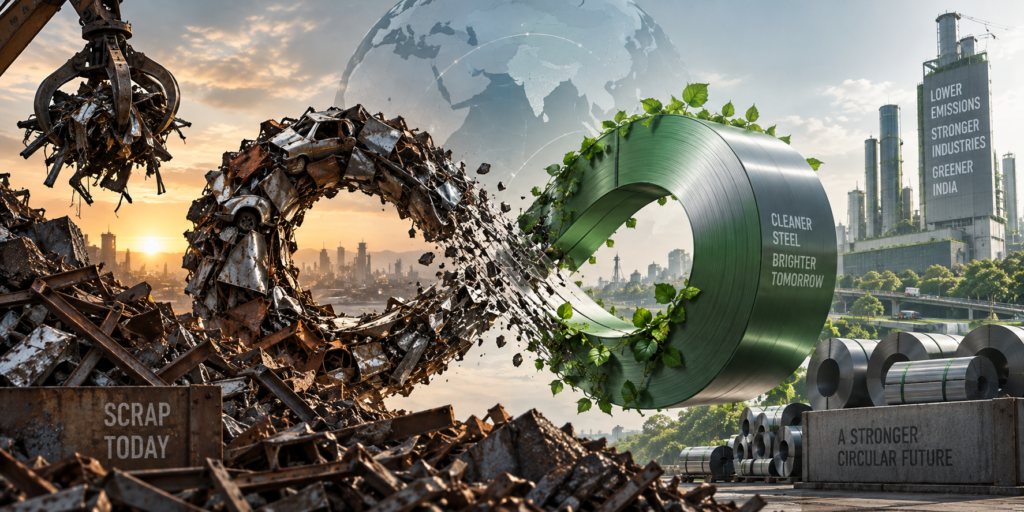
Can the world’s decarbonisation plans create a shortage of their favourite low – carbon raw material ?
The steel industry’s future is increasingly being drawn around a simple idea : melt more scrap, use less virgin material, reduce emissions and keep steel circulating through the economy.
On paper, it is an almost perfect solution.
Steel is highly recyclable. Electric Arc Furnaces can produce steel using large quantities of recycled metallics and generally have a much lower direct emissions profile than traditional blast – furnace routes, particularly when supplied with lower – carbon electricity. As steelmakers across Europe, India, the United States, the Middle East and Asia invest in EAF capacity, scrap is becoming more than something recovered from old cars and demolished buildings.
It is becoming a strategic raw material for decarbonisation.
But that creates an uncomfortable question.
If everyone wants to produce more steel from scrap, where will all the right scrap come from?
Because the problem is not that the world has no scrap.
The problem is that everybody increasingly wants the same good scrap.
The EAF Revolution Changes the Raw-Material Equation
Globally, electric – furnace steelmaking accounted for roughly 30% of crude steel production in 2025, while the traditional oxygen-route share remained around 70%. But the balance differs enormously by country. India’s electric – furnace share was already around 58% in 2025, making metallic availability especially relevant to its growth story.
As new EAF projects are built and existing steelmakers pursue lower – emission production, demand for recycled metallics is expected to become increasingly important.
This changes the raw – material equation.
A blast furnace requires iron ore, coke and other burden materials.
An EAF requires metallic units and scrap is often the obvious first choice.
The attraction is clear. Instead of reducing iron ore all over again, scrap brings iron that has already been converted into steel once before back into the production cycle.
But building another EAF does not create another scrap yard.
Capacity can be constructed in a few years.
High – quality scrap has to come from somewhere.
Scrap Has One Problem No Mine Has : You Have to Wait for It
Iron ore can theoretically be increased through additional mining, beneficiation and processing when resources, investment and permits allow.
Scrap is different.
Before steel can become scrap, it must first become something else.
- A car.
- A factory.
- A railway line.
- A bridge.
- A machine.
- A building.
Then that product may remain in service for years or decades before reaching the end of its useful life.
This creates a natural time lag between steel consumption and scrap generation.
A steel beam installed in an Indian commercial building in 2026 might eventually become excellent ferrous scrap. But if that building stands for another 40 years, the beam cannot feed an EAF being commissioned in 2030.
This is particularly relevant for fast – growing economies.
India is consuming increasing quantities of steel for infrastructure, construction, manufacturing and transport. That creates tomorrow’s scrap reservoir, but much of today’s steel is still being accumulated in the economy rather than returning immediately to furnaces.
Today’s steel growth creates tomorrow’s scrap. It does not automatically solve today’s scrap requirement.
Then Comes the Bigger Problem : A Tonne of Scrap Is Not Just a Tonne of Scrap
This is where the scrap paradox becomes much more interesting.
Scrap is extraordinarily diverse.
Heavy melting scrap from industrial structures is different from shredded automobile scrap. Manufacturing offcuts are different from demolition scrap. Turnings are different from plates. Old machinery is different from clean prompt scrap generated directly inside a manufacturing facility.
Each arrives with its own combination of density, chemistry, coatings, rust, dirt, non-ferrous contamination and residual elements.
That means two scrap suppliers can both offer 10,000 tonnes while offering completely different value to the furnace.
A plant does not ultimately buy weight.
It buys recoverable iron units with acceptable chemistry.
And as more sophisticated steel grades move toward scrap – intensive production, quality becomes increasingly important.
The Copper Problem Explains Everything
One of the most important challenges in scrap – based steelmaking is residual elements.
Copper provides the classic example.
It can enter scrap streams through electrical wiring, motors and components that are not completely separated before shredding or processing.
Once copper enters molten steel, conventional refining cannot remove it easily.
The same applies, to varying degrees, to residuals such as tin.
This matters because excessive residual concentrations can create problems in certain steel products and processing routes.
So imagine two EAF plants competing for scrap.
One simply needs general metallic feed for a relatively tolerant product.
The other is producing a demanding grade requiring tighter chemistry.
Both may technically be “scrap buyers.”
But they are not competing for exactly the same material.
The second plant needs cleaner scrap.
Multiply that across hundreds of furnaces and the real future shortage becomes clearer.
The world may not run short of scrap first.
It may run short of scrap that everybody actually wants.
Green Steel Could Therefore Create a Quality Premium
This creates an interesting economic possibility.
As EAF capacity expands, high-quality scrap could increasingly command a strategic premium.
Clean industrial scrap, well – sorted heavy scrap and other low-residual streams may become disproportionately valuable because they allow plants to increase recycled content without losing control over chemistry.
The value of better scrap is therefore not simply environmental.
It is operational.
Consider a hypothetical situation where Scrap A costs ₹31,000 per tonne and Scrap B costs ₹32,000.
If Scrap A delivers only 90% effective metallic yield while Scrap B delivers 95%, the economics look very different.
Scrap A effectively costs about ₹34,444 per recovered tonne before considering other melt-shop effects.
Scrap B works out to approximately ₹33,684 per recovered tonne.
The “expensive” scrap has become cheaper.
Now add differences in residual chemistry, slag generation, furnace time and energy consumption, and the ₹/tonne purchase price becomes even less useful on its own.
Countries Are Beginning to See Scrap Differently Too
For decades, scrap was widely treated as a globally traded secondary commodity.
But as decarbonisation strategies increase its importance, governments and industries are increasingly asking whether valuable scrap should leave domestic markets at all.
The EU, for example, has tightened its waste-shipment framework, with new rules beginning to apply progressively from May 2026 and additional restrictions affecting exports of certain waste streams to non – OECD countries from 2027.
The details vary by jurisdiction, and scrap trade remains a complex global market, but the strategic direction matters.
If countries begin treating scrap as a resource necessary for their own lower – carbon steelmaking, internationally available tonnes can become more contested.
For import-dependent buyers, that introduces another risk.
The supplier may have scrap.
The buyer may want scrap.
But regulation, domestic demand or trade policy can change how freely that scrap moves between them.
India Sits in a Particularly Interesting Position
India wants to expand steel production substantially while also reducing the emissions intensity of the sector over time.
That means the country needs several raw-material systems to develop simultaneously.
Domestic scrap collection needs to become more organised.
End – of – life vehicles and machinery need efficient recovery systems.
Demolition steel needs better segregation.
Processing and shredding capacity need to improve.
Traceability and quality classification become more important.
At the same time, Indian steelmakers still need access to other metallic units because scrap alone cannot always provide the quantity and chemistry required.
This is where the conversation becomes much broader than recycling.
Because the future EAF charge is unlikely to be 100% whatever scrap is cheapest that week.
It will increasingly be engineered.
Pig Iron and DRI Become the Balancing Metallics
If scrap quality becomes more variable or premium scrap becomes expensive, steelmakers need alternatives.
Pig iron and Direct Reduced Iron can provide cleaner, more predictable iron units that can be blended with scrap.
Imagine an EAF operator has access to economically attractive scrap, but the scrap carries residual levels that make charging it at very high percentages difficult for the required finished – steel grade.
The plant has several choices.
It can search for cleaner scrap.
It can pay a premium.
Or it can blend the available scrap with lower-residual virgin metallic units such as DRI, HBI or pig iron, depending on plant design and economics.
That is why the transition toward greater recycling does not necessarily eliminate primary iron units.
It can actually make them strategically complementary to scrap.
Scrap provides circularity.
DRI can provide relatively controlled iron units.
Pig iron can contribute high metallic yield, carbon and dilution of residuals.
The optimum mixture depends on product requirements, furnace configuration, energy prices, material availability and cost.
The Future Competition May Be for the Best Blend, Not the Most Scrap
This is an important distinction.
A plant claiming the highest possible scrap percentage is not automatically operating the most economically efficient metallic charge.
If poor – quality scrap increases electricity consumption, slag volume, yield losses, processing requirements or chemistry problems, maximising scrap percentage can create costs elsewhere.
The smarter objective is to optimize the entire metallic charge.
Perhaps one month that means more high – quality scrap.
Another month, premium scrap prices rise sharply and the economics favour a greater share of DRI or pig iron.
Another period may bring cheaper imported scrap.
Another may bring restrictions or freight disruption.
The future melt shop therefore needs flexibility.
And the future raw – material supplier needs to understand not only scrap, but how scrap interacts with the entire metallic basket.
Scrap Will Become a Data Business
As scrap becomes more valuable, the industry is also likely to become less comfortable buying it through broad descriptions alone.
Steelmakers will increasingly want to know more.
- Where did the scrap originate?
- How was it processed?
- What is its expected metallic yield?
- What are its residual levels?
- How consistent is the supplier?
- How much non-ferrous contamination is present?
- What happened when previous lots from the same source entered the furnace?
Over time, scrap procurement can move closer to the analytical approach already applied to iron ore, coal and coke.
The best scrap supplier will not simply deliver tonnes.
It will deliver predictable tonnes.
And predictability has value.
The Paradox Isn’t That the World Will Run Out of Scrap
There will be more scrap.
As global steel stocks grow and older infrastructure, vehicles and machinery reach end – of – life, enormous quantities of steel will return to the recycling system.
But demand for scrap is changing at the same time.
More EAFs want it.
Decarbonisation strategies favour it.
Governments increasingly recognise its strategic value.
And higher-quality steel production requires cleaner grades.
That means the crucial future question is not :
Will there be enough scrap?
It is :
Will there be enough of the right scrap, in the right markets, at the right quality and price?
That is a much harder problem.
Green Steel’s Most Valuable Raw Material May Be the One We Already Used Once
The steel industry’s circular future sounds beautifully simple: yesterday’s steel becomes tomorrow’s steel.
In reality, there is an entire industrial system hidden inside that sentence.
- Collection.
- Sorting.
- Processing.
- Chemistry control.
- Residual management.
- Trade.
- Logistics.
- Pricing.
And finally, intelligent blending with pig iron, DRI and other metallics.
As more countries chase lower-carbon steel, scrap will stop being viewed merely as the cheaper alternative to virgin iron.
It will increasingly become a strategic resource in its own right.
The irony of green steel may be this : the world doesn’t need to discover its most wanted raw material. It needs to become much better at recovering, sorting and sharing the steel it has already made.