
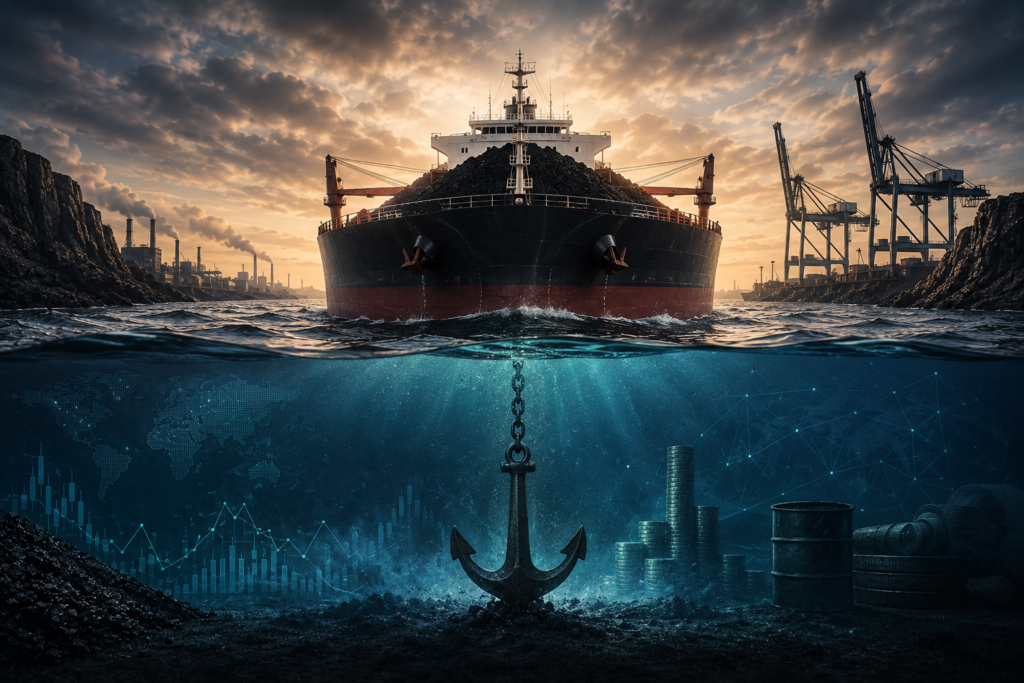
Why Shipping Costs Can Determine Steel Profitability Before the Cargo Even Arrives
When steel producers discuss raw materials, the conversation usually begins with the obvious.
- Coal.
- Metallurgical coke.
- Iron ore pellets.
- Pig iron.
- Ferrous scrap.
These materials dominate procurement meetings because they are visible, measurable and directly consumed inside the furnace. Their chemistry is analysed, their quality is tested and their prices are negotiated down to the last dollar.
Yet there is another input that quietly influences every tonne of steel produced.
- It is never charged into the blast furnace.
- It never enters the Electric Arc Furnace.
- It contains no iron.
- It burns in no kiln.
Yet it can decide whether an imported cargo is profitable or whether a carefully negotiated deal quietly becomes a financial mistake before the vessel even reaches port.
That raw material is freight.
Unlike coal or coke, freight is invisible by the time production begins. It disappears into the landed cost of every shipment. Most procurement reports mention it as a single number, often tucked away beside insurance and port handling charges.
But freight is far more than transportation.
It is a market of its own.
One driven by global trade flows, fuel prices, geopolitics, weather, shipping capacity and investor sentiment.
For trading companies and steel producers alike, understanding freight has become just as important as understanding the materials being transported.
Because in today’s steel industry, profitability often begins at sea.
The Long Journey Before Steelmaking Begins
A shipment of imported coal destined for an Indian steel plant may begin its journey in Queensland, Australia.
A cargo of metallurgical coke may leave ports in China or Poland.
Pig iron may originate in Brazil.
Ferrous scrap may be loaded in Europe, North America or the Middle East.
Before these materials reach a furnace, they often travel between 5,000 and 12,000 kilometres across oceans.
The voyage itself may last anywhere from 10 to 40 days, depending on the route, weather conditions and port schedules.
During that journey, the cargo is not producing steel.
It is producing cost.
- Every day at sea contributes to the final landed price.
- Every additional nautical mile matters.
- Every delay increases financial exposure.
By the time a shipment arrives, freight has already become part of the raw material’s true value.
The Cost You Can’t See on the Material Certificate
Every cargo arrives with a laboratory report.
Coal carries its GCV, ash, moisture and volatile matter.
Pellets arrive with iron content, compression strength and reducibility.
Scrap carries specifications regarding grade and contamination.
None of these reports mention the journey.
Yet that journey can determine whether the purchase remains commercially attractive.
Consider two identical shipments of imported coal.
Both possess the same calorific value.
- The same ash content.
- The same supplier.
- The same quality.
The only difference is freight.
One shipment was booked when freight markets were stable.
The second was booked after a major shipping disruption.
The material has not changed.
Its landed cost has.
That difference may determine procurement decisions across an entire quarter.
The Baltic Dry Index : The Market’s Early Warning System
Within global commodity markets, few indicators receive as much attention from shipping professionals as the Baltic Dry Index ( BDI ).
Often referred to as the heartbeat of dry bulk shipping, the index measures the cost of transporting major bulk commodities across international trade routes.
Unlike commodity prices, which reflect supply and demand for a specific material, the BDI reflects demand for ships.
When more cargoes compete for a limited number of vessels, freight rates rise.
When trade slows or vessel availability increases, rates decline.
The index covers key vessel categories such as Capesize, Panamax and Supramax ships, the very vessels responsible for moving coal, iron ore, grain and other bulk commodities around the world.
For steel producers, movements in the Baltic Dry Index often provide early signals of changing procurement costs.
A rising index does not merely indicate higher shipping expenses.
It often reflects stronger global commodity demand, tightening vessel availability and increased competition for logistics capacity.
In many cases, freight markets begin changing weeks before raw material prices respond.
When Fuel Prices Change, Steel Costs Follow
Every bulk carrier crossing the ocean consumes thousands of tonnes of marine fuel over the course of a voyage.
- As global oil prices rise, shipping becomes more expensive.
- Higher bunker fuel costs increase freight rates.
- Those higher freight rates increase landed raw material costs.
- Those higher raw material costs eventually influence steel prices.
The relationship may appear indirect.
In reality, it is remarkably linear.
A surge in crude oil prices rarely remains confined to the energy sector.
It gradually spreads through logistics, shipping and industrial supply chains.
For import-dependent steel producers, the impact becomes unavoidable.
Even when coal prices remain stable, freight costs may continue rising because ships themselves have become more expensive to operate.
Charter Markets : Where Steel Begins Competing for Ships
One of the least understood aspects of international trade is the charter market.
Unlike purchasing raw materials, shipping capacity itself is constantly bought and sold.
Trading companies negotiate with ship owners to secure vessels for transporting cargo.
These negotiations determine charter rates.
The charter market responds to countless variables.
- Seasonal grain exports.
- Iron ore demand from China.
- Coal imports by India.
- Weather disruptions in Australia.
- Port congestion in Brazil.
- Canal restrictions.
- Global conflicts.
Suddenly, a steel producer sourcing coal is no longer competing only with other steel producers.
They are competing with grain exporters, mining companies, fertiliser producers and agricultural traders, all seeking the same finite fleet of ships.
The cargo has already been purchased.
The challenge becomes finding a vessel to move it economically.
The Hidden Impact of Port Congestion
Ports are often viewed as simple transfer points.
- Unload the cargo.
- Load the trucks.
- Move the material.
Reality is far more complicated.
Modern ports function as complex logistical ecosystems where efficiency depends on equipment availability, labour, customs clearance, rail connectivity and berth scheduling.
When congestion occurs, vessels wait.
Every waiting vessel incurs additional costs.
Demurrage charges begin accumulating.
Customers wait longer.
Working capital remains tied up.
Production schedules become uncertain.
In severe cases, a vessel may spend more time waiting outside a port than sailing across the ocean.
For steel plants operating with lean inventories, these delays can create operational challenges long before the cargo reaches the stockyard.
Freight Volatility Is Becoming the New Normal
Historically, freight markets moved in relatively predictable cycles.
Today, volatility has become significantly more pronounced.
Global events now influence shipping almost instantly.
A conflict affecting a major trade route.
Restrictions at a strategic canal.
A hurricane disrupting export terminals.
New environmental regulations for marine fuel.
Each event alters vessel availability, voyage duration or operating costs.
What once required months to influence freight markets can now happen within days.
This volatility has transformed logistics planning into a strategic discipline rather than a routine procurement activity.
The True Landed Cost Is More Than the Invoice
Many procurement teams negotiate aggressively on commodity price.
A reduction of US$5 per tonne often represents a successful negotiation.
Yet if freight increases by US$15 per tonne during the same period, the overall purchase becomes more expensive despite the discount.
This illustrates one of the industry’s most overlooked realities.
Steel producers do not purchase Free-on-Board ( FOB ) prices.
They purchase landed costs.
The furnace never sees the commodity price negotiated at the mine.
It experiences only the total cost of getting that material safely to the plant.
Freight therefore deserves the same strategic attention as the raw material itself.
Why Trading Companies Watch Ships as Closely as Commodities
For modern trading companies, monitoring commodity markets alone is no longer sufficient.
Successful traders increasingly track :
- Shipping capacity.
- Port congestion.
- Weather systems.
- Fuel prices.
- Canal traffic.
- Freight indices.
- Insurance premiums.
- Exchange rates.
Each of these variables influences whether today’s profitable purchase remains profitable by the time cargo reaches its destination.
In many cases, logistics intelligence provides a competitive advantage equal to market intelligence.
The ability to secure a vessel at the right time can create more value than negotiating a slightly lower commodity price.
Technology Is Changing Freight Visibility
Digital shipping platforms, satellite vessel tracking and real – time logistics analytics are transforming the way trading companies manage freight.
Today, procurement teams can monitor vessel movements across oceans, estimate arrival times, analyse port congestion and identify emerging bottlenecks long before cargo arrives.
Artificial intelligence is increasingly being used to predict freight movements based on historical patterns, weather forecasts and global trade flows.
The future of freight management is becoming predictive rather than reactive.
Companies capable of anticipating disruption will consistently outperform those responding after delays have already occurred.
The Strategic Value of Freight Intelligence
The steel industry has traditionally invested heavily in understanding furnaces.
- Blast furnace optimization.
- Burden design.
- Metallurgical performance.
- Energy efficiency.
Increasingly, another area deserves similar attention.
- Logistics intelligence.
Because every tonne of steel begins with a shipment.
And every shipment begins with a transportation decision.
The companies that understand freight markets gain something far more valuable than lower shipping costs.
They gain predictability.
In an increasingly uncertain world, predictability itself has become a competitive advantage.
Every Successful Steel Shipment Begins Long Before the Cargo Is Loaded
Coal, coke, pellets, pig iron and scrap are the visible foundations of steelmaking.
Freight is the invisible one.
It quietly determines landed cost, influences procurement strategy, shapes inventory planning and often decides whether a cargo remains commercially viable.
The steel industry has spent decades optimising furnaces.
The next competitive advantage may lie in optimising the journey before the furnace.
Because the first step in making profitable steel isn’t loading raw materials into production.
It’s understanding what happens while they’re still crossing the ocean.
In a business where every dollar per tonne matters, are you negotiating the price of the cargo or truly understanding the cost of getting it to your furnace?