
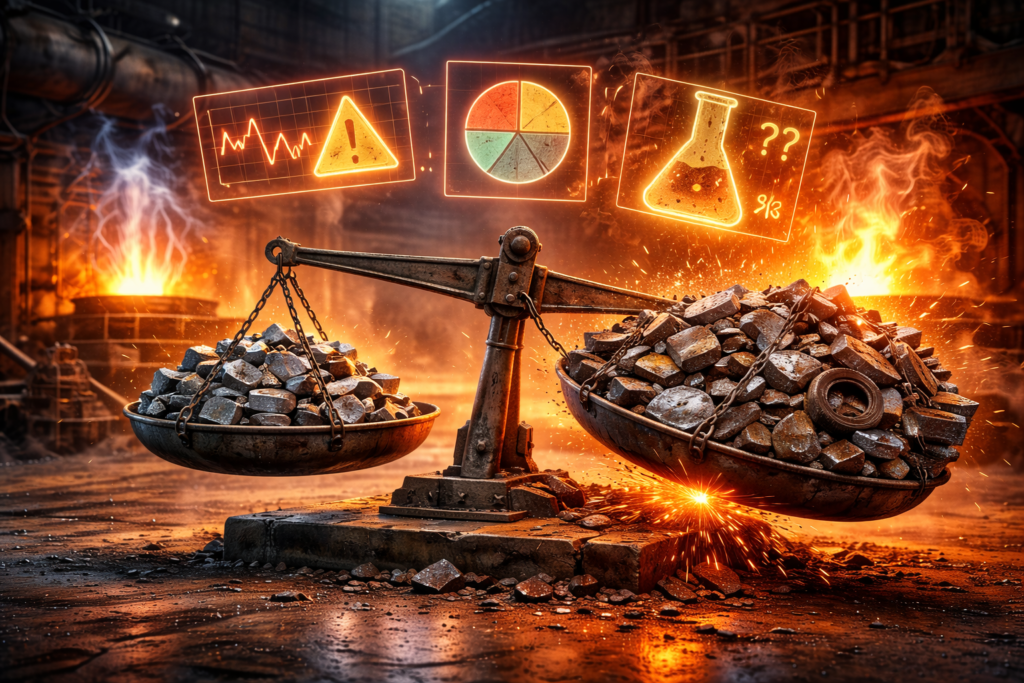
Electric Arc Furnace ( EAF ) steelmaking is often described as flexible, modern, and efficient.
It uses recycled metal.
It has lower capital intensity than integrated routes.
It supports faster production cycles.
But there is one variable that quietly destabilizes the entire system :
Scrap variability.
Unlike iron ore or pig iron, scrap is not mined or manufactured under controlled chemistry. It is collected, sorted, shredded, bundled, and blended and its composition changes constantly.
In an EAF, variability is not a minor inconvenience.
It is a cost multiplier.
The Modern EAF Charge Mix Reality
In most EAF operations :
- Scrap forms 70 – 95% of the metallic charge
- Pig iron or DRI may form 5 – 30%
- Additives and alloys are introduced for correction
The challenge is that scrap chemistry fluctuates batch-to-batch :
Typical scrap variability ranges :
- Carbon (C) : ±0.05 – 0.10%
- Copper (Cu) : ±0.10 – 0.20%
- Chromium (Cr) : ±0.10 – 15%
- Nickel (Ni) : ±0.05 – 0.10%
- Residual tramp elements accumulate over time
These may appear as small numbers, but in a 100-tonne heat :
- 0.10% extra copper = 100 kg additional Cu in melt
- 0.05% carbon deviation = 50 kg correction needed
EAFs are built for speed.
Scrap inconsistency forces them to slow down.
Longer Melt Times : The First Visible Impact
EAF productivity depends heavily on :
- Tap-to-tap time
- Arc stability
- Efficient meltdown
When scrap density and composition vary :
- Light scrap melts faster but creates arc instability
- Heavy scrap sinks and delays melting
- Coated scrap produces excess fumes and slag
Even a 3 – 5 minute extension in tap-to-tap time can significantly impact output.
Example :
If a furnace runs :
- 25 heats per day
- 4 – minute delay per heat
That equals :
- 100 minutes lost daily
- ~36,500 minutes annually
- Equivalent to 600+ operational hours
This can reduce annual output by 2 – 3%.
In a 500,000-tonne plant :
- 2% productivity loss = 10,000 tonnes
- At ₹4,000 contribution margin per tonne = ₹40 crore impact
All from scrap inconsistency.
Power Consumption Escalation
EAFs typically consume :
- 350 – 450 kWh per tonne
Scrap variability affects :
- Arc stability
- Oxygen efficiency
- Slag foaming
Inconsistent scrap often increases power usage by :
- 15 – 40 kWh per tonne
At ₹8 per kWh :
- 25 extra kWh = ₹200 per tonne
- For 500,000 tonnes → ₹10 crore annually
Power inefficiency is often blamed on operations.
But unstable scrap chemistry is frequently the root cause.
Residual Element Accumulation
Recycled scrap introduces residual elements such as :
- Copper (Cu)
- Tin (Sn)
- Chromium (Cr)
- Nickel (Ni)
These elements cannot be easily removed once present.
High copper levels (>0.30%) cause :
- Hot shortness
- Surface cracking during rolling
- Increased rejection rates
If scrap lots vary :
- Melt corrections require alloy balancing
- Additional oxygen blowing increases FeO in slag
- Metallic yield decreases
Yield in EAF operations typically ranges :
- 92 – 96%
Even a 1% drop due to scrap variability equals :
- 5,000 tonnes lost in 500,000 – tonne plant
- ₹20 – ₹25 crore revenue impact
Yield losses quietly erode margins.
Slag Instability and Refractory Wear
Scrap chemistry influences slag formation.
High residuals or inconsistent carbon levels cause :
- Excess FeO formation
- Poor slag foaming
- Higher refractory erosion
Refractory cost in EAF operations can reach :
- ₹400 – ₹700 per tonne of steel
Scrap inconsistency can increase refractory wear by :
- 8 – 12%
For a mid-sized plant, this means :
- ₹3 – ₹6 crore additional annual maintenance burden
Again, not directly visible in scrap invoices.
Alloy Correction Costs
When scrap chemistry fluctuates :
- Operators compensate with ferroalloys
- Carbon injectors increase
- Deoxidisers are adjusted
Ferroalloy cost per tonne of steel :
- ₹2,000 – ₹6,000 depending on grade
Even 2 – 3% overconsumption due to unpredictability can cost :
- ₹150 – ₹300 per tonne
Over 500,000 tonnes :
- ₹7 – ₹15 crore additional annual expense
Scrap inconsistency increases alloy dependency.
Quality Rejections & Customer Risk
Scrap variability affects final steel quality.
Common consequences :
- Mechanical property inconsistency
- Surface defects
- Rolling cracks
- Weldability issues
Customer rejection rates in EAF – based long products typically range :
- 0.5 – 1.5%
If scrap inconsistency pushes rejection up by even 0.5% :
- 2,500 tonnes downgraded
- ₹10 – ₹12 crore revenue loss
Market reputation suffers alongside profit.
Operational Stress & Human Error
Inconsistent scrap requires :
- More frequent sampling
- More chemistry adjustments
- Faster decision-making under uncertainty
Higher variability increases :
- Operator stress
- Control room interventions
- Risk of process deviation
In a system designed for rhythm, variability creates fatigue.
And fatigue creates mistakes.
The Illusion of Cheap Scrap
Scrap that is ₹1,000 – ₹2,000 per tonne cheaper may appear attractive.
But if it causes :
- ₹200 extra power cost
- ₹300 additional alloy use
- ₹400 yield loss impact
- ₹150 refractory increase
The plant may lose ₹1,000 per tonne, silently.
The invoice shows savings.
The furnace shows inefficiency.
What Efficient EAF Plants Do Differently
High – performing EAF operators :
- Maintain strict scrap segregation standards
- Use pig iron or DRI to stabilise chemistry
- Track residual trends heat-by-heat
- Blend scrap strategically
- Audit suppliers beyond pricing
They understand that :
EAF efficiency is not driven by cheap scrap.
It is driven by predictable scrap.
The Bigger Strategic Insight
EAF steelmaking is fundamentally about control.
Control of :
- Temperature
- Chemistry
- Slag
- Timing
- Yield
Scrap variability disrupts every one of these controls.
In a process where margins are often 5 – 10%,
even 1 – 2% inefficiency can wipe out competitive advantage.