
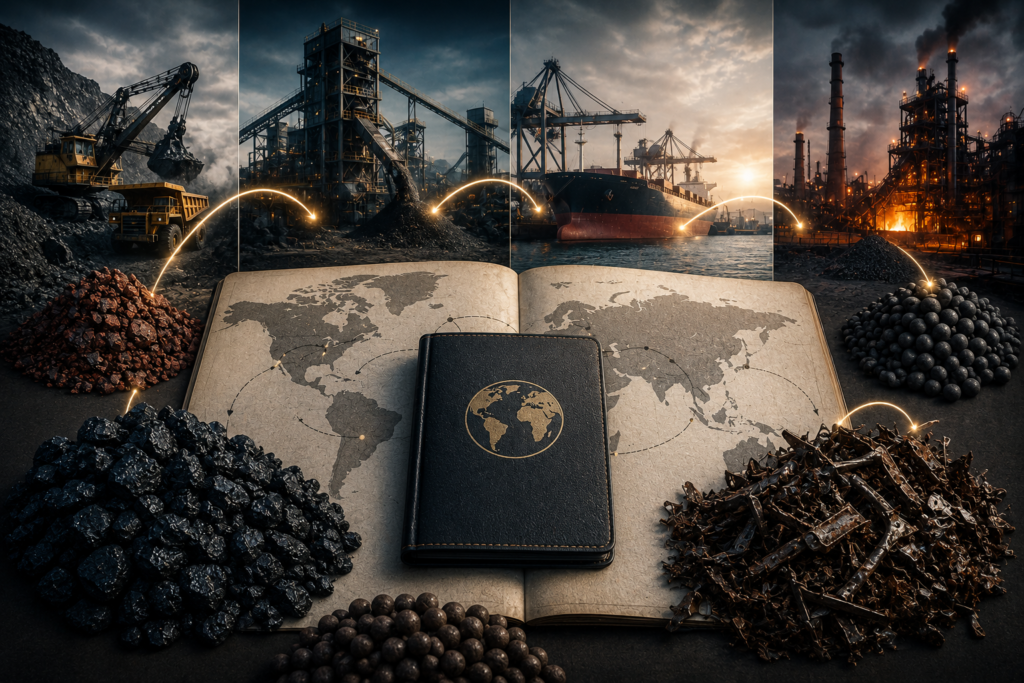
If Every Tonne of Coal, Coke, Scrap and Pellets Came with a Complete Life Story, What Would It Reveal?
Every tonne of steel begins its journey long before it reaches a blast furnace or an electric arc furnace.
Long before it becomes a beam supporting a bridge, the chassis of an automobile, or the frame of a skyscraper, it exists as something entirely different – coal buried beneath the earth, iron ore formed over millions of years, scrap collected from retired structures, or pellets produced through complex beneficiation processes.
Yet, by the time these materials arrive at a steel plant, most of their story has already been forgotten.
A laboratory certificate may describe moisture, ash, fixed carbon, or iron content.
A shipping document may state the country of origin.
A purchase order may mention quantity and price.
But none of these documents tell the complete story.
Imagine if every tonne of raw material arrived with something far more revealing – a Raw Material Passport.
Not a certificate of specification.
A complete biography.
A record of where it came from, how it was processed, how many kilometres it travelled, how it was stored, what weather it experienced, how its chemistry evolved, and ultimately, why it behaves the way it does inside a furnace.
Steel plants would stop looking at raw materials as commodities.
They would begin seeing them as journeys.
Every Raw Material Has a History Long Before It Has a Price
When procurement teams compare two cargoes of coal, the comparison usually begins with numbers.
- GCV.
- Ash.
- Moisture.
- Volatile matter.
- Price per tonne.
But none of those values explain why those numbers exist.
Two cargoes may both report a Gross Calorific Value of 6,200 kcal/kg, yet perform differently inside the same furnace.
Why?
Because the journey before arrival matters just as much as the laboratory analysis at the port.
Every raw material accumulates experiences that influence its final behaviour.
- Its geological origin.
- Its mining method.
- Its processing route.
- Its storage conditions.
- Its transport duration.
- Its exposure to rain, humidity, heat, dust and repeated handling.
The furnace ultimately reacts not only to chemistry but to history.
Chapter One : The Mine
Every passport begins with a place of birth.
For coal, that might be the Bowen Basin in Australia, the mines of Indonesia, South Africa or the United States.
For iron ore pellets, it begins with iron ore extracted from carefully selected deposits before undergoing crushing, beneficiation and pelletisation.
Pig iron begins with iron ore and coke meeting inside a blast furnace.
Scrap begins somewhere entirely different.
Perhaps it once formed part of a bridge built forty years ago.
Perhaps it was an automobile.
Perhaps an industrial machine.
Unlike newly mined materials, scrap carries an invisible history that cannot always be seen.
Every previous use influences its future metallurgy.
A tonne of scrap may already contain decades of engineering decisions within it.
Chapter Two : Processing Shapes Identity
Mining produces raw material.
Processing creates performance.
Coal is washed to reduce ash.
Iron ore is concentrated before becoming pellets.
Coking coal enters ovens where volatile compounds are driven off to produce metallurgical coke.
Scrap is sorted, shredded, separated and graded.
Every processing decision changes the material’s future behaviour.
Two pellets with identical iron content may possess completely different reducibility because of differences in induration temperature.
Two batches of coke may appear identical visually while possessing different Coke Strength after Reaction (CSR) values because of differences in coal blending before carbonisation.
Even scrap processing influences furnace performance.
Advanced shredding and separation reduce contamination.
Poor segregation increases residual elements that remain inside finished steel.
The passport records each of these transformations.
Because steel plants eventually inherit every decision made upstream.
Chapter Three : The Long Journey Across Oceans
Once processed, another chapter begins.
Transportation.
Few industries depend on international logistics as heavily as steel.
A shipment of metallurgical coal may travel more than 8,000 to 10,000 kilometres before reaching an Indian port.
Pellets move across rail corridors, ports and bulk carriers.
Scrap crosses continents through increasingly complex global recycling networks.
Pig iron may change ownership several times before reaching its final destination.
Each transfer introduces new variables.
- Loading techniques.
- Transit duration.
- Port congestion.
- Humidity.
- Mechanical handling.
- Storage at intermediate terminals.
Every additional movement changes the material in subtle ways.
Most purchase orders never record these details.
Yet they influence operational performance every day.
Chapter Four : The Forgotten Warehouse
Many people assume the journey ends once cargo reaches the plant.
In reality, another chapter begins.
Storage.
This is often the least discussed phase of a raw material’s life and one of the most influential.
Coal stored for sixty days does not behave exactly like coal consumed within one week.
Oxidation begins almost immediately after exposure to air.
Moisture changes with rainfall and humidity.
Repeated reclaiming creates additional fines.
Volatile matter gradually declines.
A material that was sampled and approved at the port may quietly evolve before ever entering the furnace.
Similarly, pellets exposed to repeated handling experience abrasion, generating fines that influence burden permeability.
Scrap stored outdoors may accumulate moisture, rust, dirt and contamination.
Even metallurgical coke loses strength through unnecessary handling.
The passport would document not only where materials were stored, but how long they remained there and under what environmental conditions.
Because storage does not simply preserve materials.
It changes them.
Chapter Five : Blending – Where Individual Stories Become One
Steel plants rarely consume raw materials exactly as they arrive.
Instead, they blend.
Coal from multiple origins is combined to achieve desired coke quality.
Scrap grades are mixed to balance chemistry.
Pellets are charged alongside sinter and lump ore.
Pig iron stabilises metallic charges when scrap quality varies.
Blending is one of the industry’s most sophisticated sciences.
It recognises a simple reality.
No raw material exists in isolation.
Each one influences the behaviour of another.
An effective blend compensates for individual weaknesses while maximising collective performance.
In many ways, blending resembles assembling an orchestra.
Each instrument matters.
But success depends on how they perform together.
The passport would not stop with individual materials.
It would record the combinations they became part of and how those combinations performed.
Chapter Six : Quality Never Stands Still
Perhaps the most misunderstood concept in raw material management is the belief that quality remains fixed.
It does not.
Quality evolves continuously.
Coal oxidises.
Scrap accumulates contamination.
Pellets generate fines.
Coke experiences degradation through repeated handling.
Moisture fluctuates daily.
Laboratory certificates represent a single moment in time.
Operations teams work with material that continues changing every hour after that certificate was issued.
This explains why two cargoes with identical specifications sometimes behave differently.
The passport would reveal not only original quality but quality evolution.
Instead of asking :
What was the ash content when it arrived?
Plants might ask :
What was the ash, moisture and particle size when it entered the furnace?
Those are often very different questions.
The Future of Procurement Is Traceability
Across industries, traceability is becoming increasingly valuable.
Consumers now expect to know where food comes from.
Manufacturers trace components across global supply chains.
Pharmaceutical companies monitor products from production to patient.
Steelmaking is moving in the same direction.
Increasingly, producers want to know :
- Where was this coal mined?
- How long did it remain in transit?
- How many times was it handled?
- How long has it been in storage?
- Which blend was it part of?
- How did it perform compared to previous cargoes?
The future is not simply about buying better raw materials.
It is about understanding them more completely.
Why the Passport Could Change Everything
I
magine opening a digital record for every cargo.
Instead of seeing only chemistry, you also see :
- Its geological origin.
- Its mining conditions.
- Its washing process.
- Its transport history.
- Weather exposure during transit.
- Storage duration.
- Blending records.
- Historical furnace performance.
- Yield achieved.
- Fuel consumption.
- Slag generation.
- Maintenance impact.
Suddenly procurement becomes predictive instead of reactive.
Instead of asking whether a shipment meets specification, plants begin asking whether its history suggests consistent performance.
That shift has enormous implications.
The Hidden Competitive Advantage
The steel industry has traditionally competed through scale.
Then through efficiency.
Today it increasingly competes through knowledge.
The companies that understand their raw materials beyond laboratory reports gain an advantage that is difficult to replicate.
Because better decisions come from better information.
And better information begins with better traceability.
The raw material itself has not changed.
Only the understanding of it has.
Every Tonne Has a Story Worth Knowing
Steel plants often purchase thousands of tonnes of coal, coke, pellets, pig iron and scrap every month.
Invoices describe them.
Specifications classify them.
Contracts value them.
But none of these documents explain their journey.
Yet it is that journey that often determines how they perform.
Perhaps the next evolution in steelmaking will not begin with a new furnace design or a breakthrough technology.
Perhaps it will begin with something much simpler.
The ability to understand every raw material not just by what it is, but by where it has been.
Because the most valuable information inside a steel plant may not be hidden in the furnace.
It may already exist inside the passport of the material waiting outside it.
The Next Question the Industry Should Be Asking
If every tonne of raw material carried its complete life story, would we still make the same procurement decisions or would we finally begin buying with the future performance of the furnace in mind?