
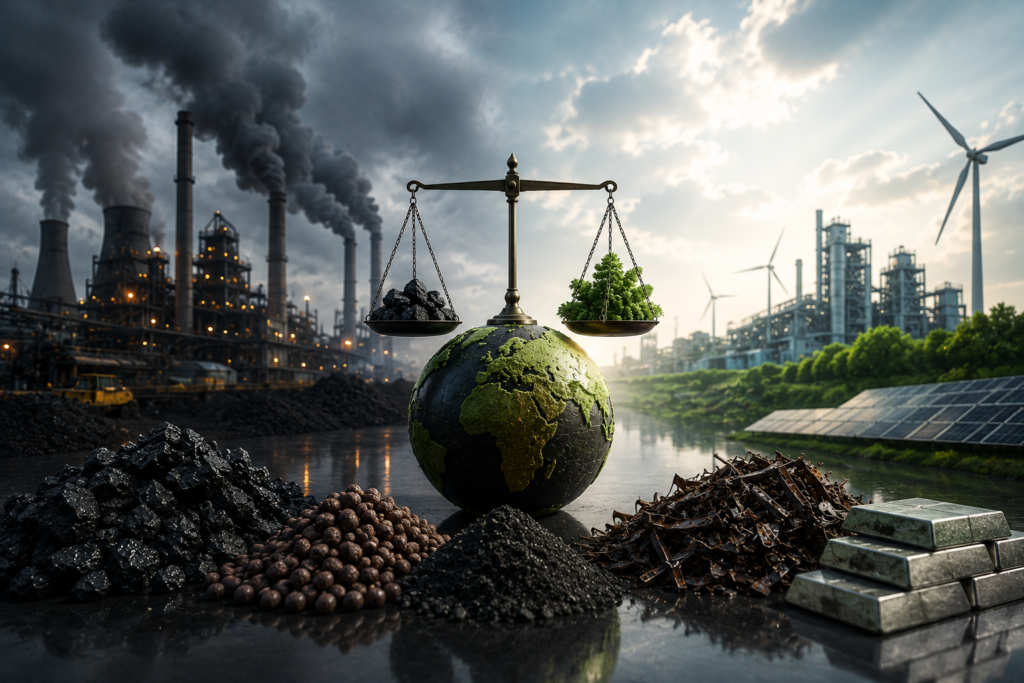
How Carbon Pricing Is Quietly Changing Raw Material Decisions Across the Steel Industry
For more than a century, steelmaking has been driven by three fundamental questions.
Can we produce more?
Can we produce faster?
Can we produce cheaper?
These questions shaped investment decisions, procurement strategies, furnace designs and global supply chains. Coal was selected for its calorific value. Coke was evaluated for its strength. Iron ore was purchased for its iron content. Scrap was priced based on availability, and freight costs often determined sourcing decisions.
Carbon emissions rarely entered the conversation.
They were measured for environmental reporting, discussed in sustainability reports and occasionally reviewed during regulatory audits, but they rarely influenced commercial decisions inside procurement meetings.
That is rapidly changing.
Today, steel producers around the world are discovering that carbon is no longer simply an environmental issue.
It is becoming a financial one.
Increasingly, every tonne of carbon emitted during steel production carries an economic consequence. Whether through carbon taxes, emissions trading systems, border adjustment mechanisms or customer sustainability requirements, carbon has quietly evolved into another production cost – just like electricity, labour, freight or raw materials.
The implications extend far beyond environmental compliance.
They are fundamentally changing how steel is produced, how raw materials are selected and how procurement teams evaluate value.
The day carbon became a business cost, the economics of steelmaking began to change.
Steel Is One of the World’s Most Carbon-Intensive Industries
Steel remains one of the foundations of modern civilization.
Every bridge, railway, airport, automobile, factory, transmission tower and commercial building depends on it.
Yet producing steel requires enormous amounts of energy.
Globally, the steel industry accounts for approximately 7 – 9% of total carbon dioxide emissions, making it one of the largest industrial sources of greenhouse gases.
The reason lies in the production process itself.
Traditional blast furnace operations rely heavily on metallurgical coal and coke, not only as fuel but also as chemical reducing agents that remove oxygen from iron ore.
This reaction inevitably produces carbon dioxide.
A conventional Blast Furnace – Basic Oxygen Furnace (BF-BOF) route typically emits between 1.8 and 2.3 tonnes of CO₂ for every tonne of crude steel produced.
By comparison, gas-based Direct Reduced Iron (DRI) routes generally produce 1.0 to 1.4 tonnes of CO₂, while Electric Arc Furnaces (EAFs) operating on high – quality scrap with renewable electricity can reduce emissions even further.
For decades, these differences mattered primarily to environmental specialists.
Today, they increasingly influence commercial competitiveness.
Carbon Has Entered the Procurement Conversation
Procurement teams once compared suppliers based on a familiar set of questions.
- Who offers the best price?
- Who delivers consistently?
- Which cargo arrives fastest?
Those questions still matter.
But increasingly, another question is appearing alongside them.
What is the carbon footprint of this shipment?
The answer may influence purchasing decisions just as much as price.
Because every tonne of coal, every shipment of coke, every batch of pellets and every load of scrap now carries not only a commercial value, but also an emissions profile.
The steel industry is gradually shifting from purchasing raw materials based solely on physical characteristics to evaluating them through an environmental and economic lens simultaneously.
Understanding Carbon Pricing
Carbon pricing is based on a simple principle.
If emitting carbon creates environmental costs for society, those costs should eventually be reflected in business decisions.
Different countries achieve this through different mechanisms.
Some introduce carbon taxes.
Others operate emissions trading systems where companies purchase carbon allowances.
Several governments now impose reporting requirements that gradually evolve into financial obligations.
Regardless of the model, the objective remains similar.
Carbon emissions become measurable.
Then they become reportable.
Eventually, they become chargeable.
Once that happens, emissions stop being abstract numbers in sustainability reports.
They become production costs.
Why CBAM Is Changing Global Steel Trade
Perhaps the most significant development affecting steel exports is the introduction of the Carbon Border Adjustment Mechanism (CBAM) by the European Union.
CBAM was developed to address a growing concern.
If European steel producers operate under strict carbon regulations while imported steel is produced under less stringent environmental standards, imported products may gain an unfair cost advantage.
The mechanism seeks to balance that difference.
Rather than focusing only on where steel is produced, CBAM increasingly considers how it is produced.
For exporters, this changes the conversation dramatically.
Customers may no longer ask only about chemical composition, tensile strength or delivery schedules.
They may also request verified emissions data for every tonne supplied.
In effect, carbon becomes another product specification.
Every Raw Material Now Carries an Emissions Story
Raw materials have always carried physical properties.
Now they increasingly carry environmental ones as well.
Coal from one origin may produce different emissions during mining, washing and transportation than coal sourced elsewhere.
Pellets produced using renewable electricity may carry a lower embedded carbon footprint than pellets manufactured using conventional energy.
Scrap possesses one of the lowest embodied carbon footprints among metallic inputs because it reuses existing steel rather than producing iron from virgin ore.
Pig iron, meanwhile, provides valuable metallurgical stability but also carries emissions associated with blast furnace production.
Procurement decisions therefore become significantly more complex.
The lowest – cost material may no longer represent the lowest total cost once carbon obligations are considered.
The Rise of Carbon Accounting
Financial accounting transformed business by measuring money.
Carbon accounting is beginning to transform industry by measuring emissions.
Increasingly, companies track carbon throughout the supply chain.
Not only inside their own operations.
But across suppliers, transportation networks and production processes.
A shipment of metallurgical coal may now be evaluated not only for ash, volatile matter and calorific value, but also for emissions associated with mining, processing, transportation and handling.
This broader perspective allows steel producers to understand where carbon is generated and where meaningful reductions are possible.
Carbon accounting is gradually becoming as important as cost accounting.
Raw Material Selection Is Quietly Evolving
For decades, procurement focused on immediate operational performance.
Now, long-term environmental costs increasingly influence raw material strategy.
Higher – quality pellets can improve reduction efficiency, lowering fuel consumption.
Premium metallurgical coke may reduce coke rates inside blast furnaces.
Better – quality coal can improve combustion stability, reducing unnecessary energy use.
Higher-quality scrap often melts more efficiently, reducing electricity consumption inside Electric Arc Furnaces.
None of these decisions eliminate emissions entirely.
But they improve efficiency.
And improved efficiency generally means lower carbon intensity.
In the emerging carbon economy, operational efficiency and environmental performance increasingly reinforce one another.
Why Freight Now Matters Twice
Freight has always influenced landed cost.
Now it also influences carbon intensity.
A shipment travelling 10,000 kilometres naturally generates more transport emissions than one sourced regionally.
While ocean freight remains relatively efficient compared to other transport modes, growing emphasis on supply chain emissions is encouraging companies to evaluate logistics differently.
The future procurement model may no longer optimize only for cost.
It may optimize for both cost and carbon simultaneously.
The New Economics of Scrap
No discussion about carbon would be complete without considering ferrous scrap.
Recycling steel dramatically reduces the energy required for production compared with producing virgin iron.
Using scrap inside Electric Arc Furnaces can reduce emissions significantly, particularly when powered by low-carbon electricity.
As countries pursue decarbonisation goals, competition for high – quality scrap is expected to intensify.
This shift is already influencing international scrap trade.
What was once viewed primarily as industrial waste is increasingly recognised as a strategic raw material for low-carbon steelmaking.
The Competitive Landscape Is Changing
Historically, steel producers competed through :
- Scale.
- Capacity.
- Production cost.
Today another factor is emerging.
- Carbon efficiency.
Customers increasingly ask for Environmental Product Declarations.
Investors evaluate sustainability performance.
Governments introduce emissions reporting frameworks.
Financial institutions consider climate-related risks.
Carbon is gradually becoming embedded within commercial competitiveness.
Companies capable of producing steel with lower emissions may enjoy broader market access, improved financing opportunities and stronger long-term positioning.
Why This Matters for Trading Companies
The transformation does not affect steel producers alone.
Trading companies are also entering a new era.
Customers increasingly expect suppliers to understand :
Product origin.
Embedded emissions.
Supply chain traceability.
Future regulatory developments.
A trading partner is no longer simply expected to supply cargo.
Increasingly, they are expected to provide transparency.
That requires deeper knowledge of suppliers, processing routes and logistics than ever before.
The role of the trader is expanding from procurement specialist to supply chain advisor.
Carbon Will Influence More Than Compliance
Many businesses still view carbon reporting as an administrative exercise.
In reality, it is becoming a strategic one.
As carbon pricing expands globally, procurement decisions made today may influence competitiveness for years to come.
The companies that begin understanding embedded emissions now will likely adapt more smoothly than those waiting for regulations to become mandatory.
Because by the time carbon appears as a line item on financial statements, the competitive landscape may have already shifted.
The Future of Steel Will Be Measured in More Than Tonnes
Steel has always been measured by output.
- Tonnes produced.
- Tonnes sold.
- Tonnes shipped.
The future will require another measurement.
Tonnes of carbon emitted per tonne of steel.
That single ratio is increasingly influencing technology investment, procurement strategy, customer expectations and international trade.
The steel industry is entering an era where efficiency is no longer defined only by productivity.
It is also defined by environmental performance.
Carbon Is No Longer an Environmental Statistic, It Is a Commercial Reality
For generations, raw material decisions were driven almost entirely by economics.
Today, economics itself is evolving.
Carbon has moved from environmental reports into boardroom discussions.
From sustainability teams into procurement meetings.
From policy documents into commercial contracts.
The companies that recognise this transition early will not simply comply with future regulations.
They will position themselves to compete in a marketplace where environmental efficiency increasingly creates economic advantage.
Because the question is no longer whether carbon will influence the steel industry.
It already does.
The only question is how quickly businesses adapt to treating carbon as one more cost that must be understood, measured and managed.