
DRI vs Blast Furnace Economics Under Volatile Energy Conditions
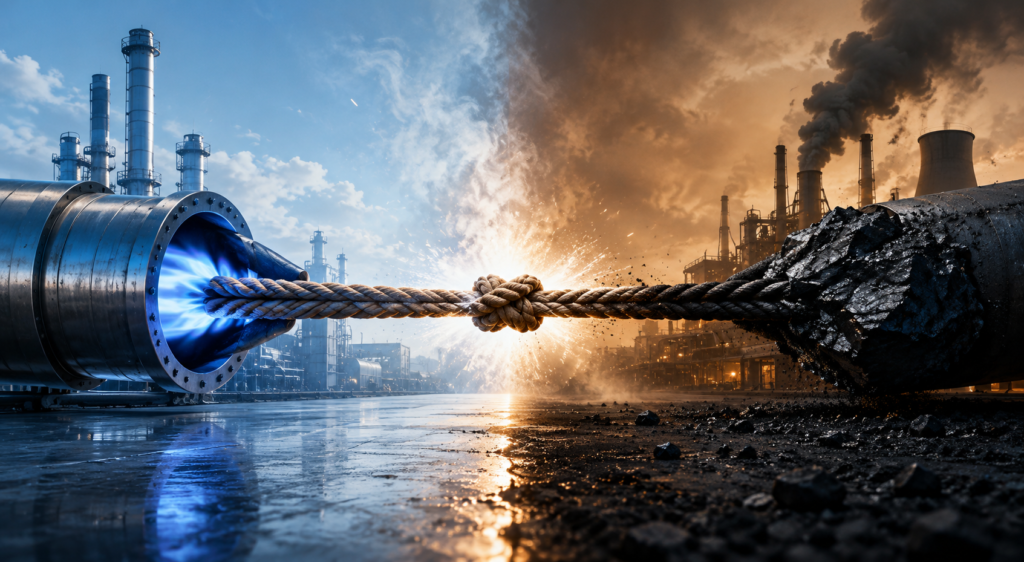
For decades, the steel industry operated on relatively stable assumptions.
Blast furnaces relied on coal and coke.
DRI plants depended on natural gas.
Electric Arc Furnaces expanded where electricity and scrap economics made sense.
The boundaries were clear.
Today, they are not.
Because in 2026, steel production is increasingly becoming a contest between energy systems.
Not steel technologies.
Not furnace designs.
Energy.
The real competition is unfolding between :
Gas-based steelmaking vs Coal-based steelmaking
And this competition is quietly reshaping :
- Global steel economics
- Raw material demand
- Investment strategies
- Carbon emissions
- Geopolitical dependence
The question is no longer :
Which steelmaking route is more efficient?
The question is :
Which energy source is more survivable in a volatile world?
Steelmaking Has Always Been an Energy Story
Steel production is essentially the conversion of :
Energy + Iron → Metal
The route determines which energy dominates.
Route 1 : Blast Furnace ( BF – BOF )
Primary energy :
- Metallurgical coal
- Coke
- Pulverized coal injection (PCI)
Typical consumption :
- 300 – 450 kg coke/tonne hot metal
- 450 – 550 kg coal equivalent/tonne steel
Energy requirement :
- 20 – 30 GJ/tonne steel
Global share :
- ~70% of steel production
Route 2 : DRI + EAF
Primary energy :
- Natural gas ( or hydrogen in future models )
Gas consumption :
- 2.5 – 3.0 Gcal/tonne DRI
Energy requirement :
- 10 – 18 GJ/tonne steel
Global share :
Growing rapidly.
Why DRI Became Attractive
Gas – based DRI gained popularity because it offered :
Lower emissions
Compared to BF route :
- 30 – 50% lower CO₂ emissions
Cleaner metallic input
Advantages :
- Lower sulphur
- Controlled chemistry
- Reduced impurities
Regulatory alignment
As ESG pressure increased :
Gas – based production looked like the future.
For years, the narrative was :
Gas = cleaner future
Coal = legacy system
Then energy politics changed.
The Assumption That Broke : Cheap Gas Is Not Guaranteed
DRI economics depend heavily on one variable :
Stable gas supply
When gas prices rise. everything changes.
Example Cost Sensitivity
Gas cost increase :
+30 – 50%
Possible impact
DRI cost increase :
₹2,000 – ₹4,000 per tonne
In extreme volatility :
Production may become uneconomical.
What Happens When Gas Prices Spike?
The sequence often looks like :
Gas shortage
↓
DRI cost rises
↓
DRI production drops
↓
Scrap demand increases
↓
Pig iron demand rises
↓
Blast furnace competitiveness improves
Meanwhile, Coal Isn’t Stable Either
Coal faces its own challenges :
- Geopolitical tension
- Shipping risk
- Environmental regulation
- Export restrictions
India imports approximately :
85 – 90% of coking coal requirements
This creates dependence.
Coal Cost Volatility Example
Freight increase :
+$10/tonne
Potential impact
Steel production cost :
₹800 – ₹1,200/tonne increase
Coal may remain available.
But availability ≠ affordability.
2026 : The Era of Competing Risks
Previously :
Gas seen as risk reduction
Today :
Both systems carry different vulnerabilities
Gas Risks
- Price volatility
- Geopolitical exposure
- Supply restriction
- Policy dependence
Coal Risks
- Freight volatility
- Carbon pressure
- Trade disruption
- Import dependency
Steelmakers increasingly choose between :
Energy uncertainty A & Energy uncertainty B
The Carbon Equation Is Changing the Debate
Global climate targets increasingly favor :
- Lower carbon steel
- DRI expansion
- Hydrogen transition pathways
Typical emissions :
BF route :
Approx :
1.8 – 2.3 tonnes CO₂ per tonne steel
Gas DRI route :
Approx :
1.0–1.4 tonnes CO₂
Difference
Potential reduction :
30 – 50%
This gives DRI strategic importance.
Even if economics fluctuate.
But Carbon Reduction Has a Cost
Lower emissions often mean :
Higher sensitivity to :
- Gas pricing
- Infrastructure availability
- Policy changes
Cleaner production does not always mean :
More resilient production.
Why Some Producers Are Returning to Coal – Based Strength
Unexpected trend :
Certain regions continue investing in :
- Blast furnaces
- Coke capacity
- Coal security
Reason : Reliability
In volatile markets : Predictable fuel may outperform cleaner fuel.
The Rise of Hybrid Strategies
Leading steelmakers increasingly avoid :
Single – route dependence
Instead they build flexibility :
Combination approach
- BF operations
- DRI capability
- Scrap integration
- EAF expansion
Goal
Adapt to energy conditions.
The future may belong to :
Flexible producers
Not fixed systems.
The Hidden Winner : Metallurgical Coke
When gas becomes expensive :
Demand shifts towards :
- Blast furnaces
- Coke consumption
Result :
Coke moves from
Commodity to Strategic fuel
The Raw Material Chain Reaction
Energy change
↓
Gas cost rises
↓
DRI becomes expensive
↓
Scrap competition increases
↓
Pig iron demand rises
↓
Blast furnace reliance increases
↓
Coke demand rises
↓
Coal procurement increases
↓
Freight rises
↓
Steel cost rises
2026 May Not Be About Gas Winning or Coal Winning
The bigger shift :
Steelmakers may stop asking :
Which fuel is cheaper?
And start asking :
Which system is less exposed?
What Smart Producers Are Watching in 2026
Forward – looking steelmakers monitor :
- LNG pricing
- Coal freight indices
- Carbon regulation
- Geopolitical risk
- Energy policy
- Gas allocation trends
Because energy now determines :
- Competitiveness
- Margins
- Production stability
Steel Is Becoming an Energy Risk Business
Historically :
Steel competed through :
- Scale
- Labor
- Procurement
Increasingly :
The competitive edge may come from :
Energy Resilience