
How wars disrupt coal routes, scrap flows, freight rates, and steel pricing weeks before the news catches up
Not through headlines but through delayed vessels, rising freight quotes, inconsistent scrap quality, and sudden price corrections.
Steel is one of the earliest industries to react to geopolitical tension because it depends on globally interconnected raw material flows :
- Coal from Australia, Indonesia, South Africa
- Scrap from the US, Europe, Middle East
- Pig iron from Russia, Ukraine, Brazil
- Pellets from Brazil, Middle East, India
When conflict begins even before escalation, these flows start shifting.
And the impact shows up weeks before the world notices.
Why Steel Feels Conflict First
Steel sits at the intersection of :
- Energy
- Infrastructure
- Manufacturing
- Global trade
It consumes raw materials at massive scale :
- ~1.9 billion tonnes of steel produced globally per year
- 700+ million tonnes of seaborne coal trade annually
- 600+ million tonnes of scrap traded globally
This makes steel extremely sensitive to :
- Shipping disruptions
- Sanctions
- Fuel price volatility
- Currency movements
Even minor geopolitical signals can trigger major supply chain reactions.
1. Coal Routes Shift Before Supply Falls
Coal is the first to react, not because supply disappears, but because routes become uncertain.
What happens immediately :
- Shipping insurance premiums rise
- Vessel rerouting begins
- Charter rates increase
- Buyers rush to secure cargo
For example :
- Freight rates can jump 20–50% within days of geopolitical tension
- War-risk premiums can increase shipping cost by $3–$10 per tonne
Even if coal supply remains unchanged, land cost increases instantly.
Operational Impact on Plants
Higher freight leads to :
- sudden increase in fuel cost
- Pressure on furnace margins
- Procurement panic buying
In blast furnace operations :
- Coal cost contributes 30 – 40% of hot metal cost
A $10/tonne increase in coal landed cost can raise :
- Steel production cost by ₹800–₹1,200 per tonne
Plants feel this before any official supply shortage is reported.
2. Scrap Markets React Faster Than Any Other Raw Material
Scrap is the most volatile raw material during geopolitical uncertainty.
Why?
Because scrap is :
- Highly traded
- Easily redirectable
- Sensitive to export policies
Immediate effects of conflict :
- Export restrictions or slowdowns
- Hoarding by suppliers
- Reduced availability in key markets
Scrap prices can move :
- $30 – $80 per tonne within 2 – 3 weeks
In some past disruptions, price spikes of :
15–25% within a month
have been recorded.
Operational Impact in EAF Plants
EAF steelmaking relies on :
- 70 – 90% scrap in metallic charge
When scrap flow becomes uncertain :
- Plants shift to lower-quality scrap
- Chemistry variability increases
- Pig iron demand rises
This leads to :
- Higher power consumption
- More alloy correction
- Reduced yield
Even a 1% yield drop in a 500,000 tonne plant can cost :
- ₹20 – ₹25 crore annually
3. Pig Iron Becomes a Strategic Commodity Overnight
Pig iron is often overlooked until scrap becomes unreliable.
During conflict :
- Pig iron supply tightens
- Export flows from key regions are disrupted
- Prices rise sharply
Historical observations show :
- Pig iron prices can increase by 20 – 40% within weeks of supply disruption
Why Demand Spikes
When scrap becomes inconsistent :
- EAF plants increase pig iron usage to stabilise melt chemistry
- Foundries secure additional inventory
Pig iron shifts from :
supplementary material → critical stabiliser
This sudden demand surge tightens supply further.
4. Pellet Supply Tightens Through Indirect Effects
Pellets are less volatile than scrap but still affected.
Conflict impacts :
- Mining operations
- Port availability
- Shipping schedules
Even without direct supply cuts :
- Vessel delays increase
- Delivery timelines extend
Typical impact :
- Lead times increase by 7 – 20 days
- Prices rise by 5 – 15%
Operational Impact
Pellets are critical for :
- DRI plants
- Blast furnace burden stability
Delays force plants to :
- Increase reliance on lower-grade ore
- Adjust burden mix
- Increase fuel consumption
Even a 2% drop in reduction efficiency can increase fuel cost significantly.
5. Freight Becomes the Biggest Hidden Cost
One of the earliest and most underestimated impacts of conflict is freight escalation.
Shipping markets react instantly to :
- Route risks
- Port congestion
- Fuel price spikes
Typical freight changes during tension :
- Bulk shipping rates increase by 25 – 60%
- Container and bulk availability drops
For raw materials :
- Freight can account for 15 – 25% of landed cost
A $15 increase in freight can :
- Erase procurement savings
- Distort cost calculations
- Force renegotiation of contracts
6. Currency and Trade Flows Add Pressure
Geopolitical events often trigger :
- Currency volatility
- Trade restrictions
- Sanctions
For import-dependent countries :
- Currency depreciation increases landed cost
- LC (Letter of Credit) conditions tighten
- Payment cycles become longer
Even a 5% currency movement can significantly impact raw material cost.
7. Steel Prices Move Last, But Fastest
Interestingly, finished steel prices react after raw material markets.
Why?
Because :
- Producers try to absorb cost initially
- Inventory buffers delay price changes
- Contracts delay adjustments
But once raw material pressure builds :
- Steel prices adjust sharply
Typical pattern :
- Raw material prices rise first
- Steel prices follow after 2 – 4 weeks
- Market correction happens rapidly
Price increases of :
- ₹2,000 – ₹5,000 per tonne can occur within weeks
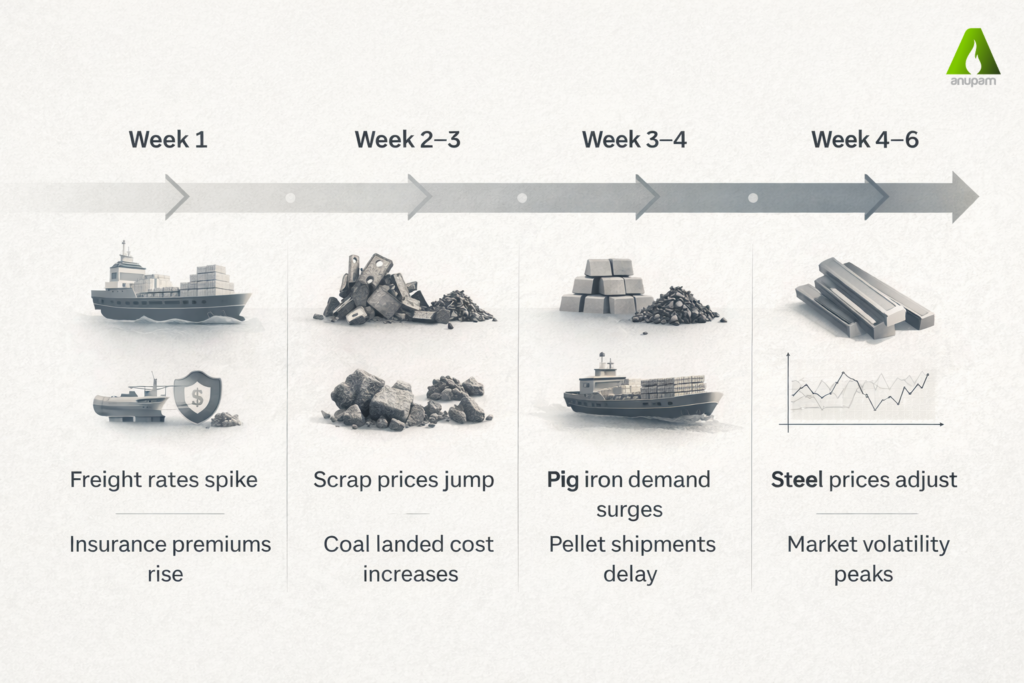
The Timeline of Impact
A typical conflict-driven disruption unfolds like this :
Week 1 :
- Freight rates spike
- Insurance premiums rise
Week 2 – 3 :
- Scrap prices jump
- Coal landed cost increases
Week 3 – 4 :
- Pig iron demand surges
- Pellet shipments delay
Week 4 – 6 :
- Steel prices adjust
- Market volatility peaks
By the time headlines focus on steel, the industry has already absorbed the shock.
Why the Impact Feels “Sudden”
To outsiders, price spikes look abrupt.
But inside the industry, they are the result of :
- early supply chain shifts
- procurement reactions
- inventory adjustments
Steel does not react late.
It reacts early but quietly.
How Smart Players Respond Early
Advanced steelmakers and suppliers monitor :
- Shipping patterns
- Freight indices
- Scrap booking trends
- Port congestion
- Currency movement
They act before disruption becomes visible.
Typical strategies include :
- Forward booking raw materials
- Diversifying sourcing
- Increasing inventory buffers
- Adjusting product pricing early
Early action reduces shock impact.
Steel Moves Before the News
Steel is not just an industrial product.
It is a real-time indicator of global disruption.
When :
- Freight rises
- Scrap tightens
- Coal costs shift
The industry already knows something is coming.
Long before headlines confirm it.