
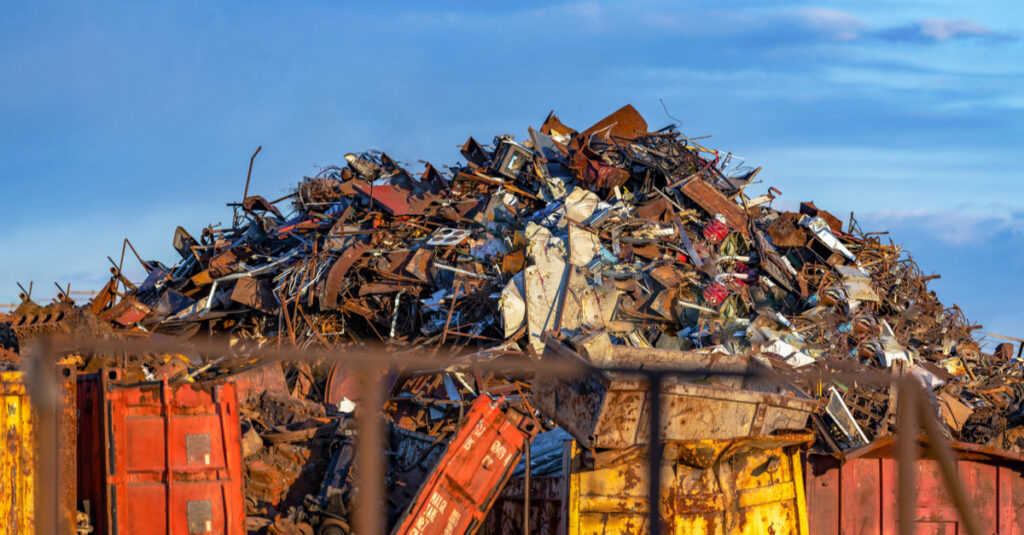
On the surface, the global steel industry is moving in the right direction.
More recycling.
Lower emissions.
Greater reliance on Electric Arc Furnaces (EAFs).
Scrap, once considered secondary, is now positioned as the future of green steelmaking.
But beneath this transition lies a growing, uncomfortable reality :
Not all scrap is equal.
And high-quality scrap is becoming harder to find.
What looks like abundance is, in reality, a quality crisis.
The Global Shift Toward Scrap – Based Steel
Steel production is increasingly moving toward EAF routes.
Current global trends :
- ~30–35% of global steel is produced via EAF
- In developed markets (US, EU) : 60–75% EAF share
- India is rapidly expanding scrap-based capacity
Why?
Because scrap-based steel :
- Emits 60–70% less CO₂ than blast furnace routes
- Requires lower capital investment
- Enables flexible production
This has triggered a surge in scrap demand.
The Scale of Scrap Demand
Global scrap consumption :
- ~600–650 million tonnes annually
- Expected to cross 800 million tonnes by 2030
At the same time :
- Steel demand continues to grow
- Infrastructure and automotive sectors are expanding
- Green steel targets are accelerating scrap usage
But supply is not growing at the same pace, especially quality supply.
The Core Problem : Scrap Is Not Homogeneous
Scrap is not mined.
It is collected, processed, and recycled.
And its quality depends on :
- Source material
- Age of steel
- Level of contamination
- Sorting efficiency
Broad categories :
- Heavy melting scrap (HMS)
- Shredded scrap
- Busheling (high-quality, low-residual scrap)
- Turnings and mixed scrap
Only a fraction of global scrap qualifies as premium, low-residual scrap.
1. The Decline of Prime Scrap Availability
Prime scrap (busheling, industrial scrap) comes from :
- Manufacturing processes
- Automotive stamping
- Clean steel waste
This is the highest quality scrap :
- Low copper
- Low tin
- Consistent chemistry
But here’s the issue :
As manufacturing efficiency improves :
- Less scrap is generated per unit of production
- Automotive and appliance industries are optimizing material usage
Result :
- Prime scrap supply is shrinking relative to demand
Numbers That Matter
- Prime scrap forms only 15 – 20% of total scrap supply globally
- Demand for prime scrap is growing faster than overall scrap availability
This creates a structural imbalance.
2. Rising Residual Elements in Scrap Pools
As scrap recycling increases, residual elements accumulate.
Key problematic elements :
- Copper (Cu)
- Tin (Sn)
- Nickel (Ni)
- Chromium (Cr)
These elements :
- Cannot be easily removed during steelmaking
- Build up over repeated recycling cycles
Why This Matters
High copper (>0.30%) leads to :
- Hot shortness
- Surface cracking
- Poor rolling performance
Even small increases :
- 0.10 – 0.15% Cu variation can significantly affect product quality
As more lower-quality scrap enters the system :
- Overall scrap pool quality declines
3. Scrap Contamination Is Increasing
Modern scrap contains more contaminants than before.
Reasons :
- Increased use of coatings (galvanized steel)
- Mixed material products
- Complex assemblies (electronics, vehicles)
Common contaminants :
- Plastics
- Rubber
- Coatings
- Non-ferrous metals
Operational Impact
Contaminated scrap leads to :
- Higher slag formation
- Increased energy consumption
- Unstable melting behavior
EAF operators report :
- 15 – 40 kWh per tonne higher energy consumption with lower-quality scrap
At ₹8 per unit :
- ₹120 – ₹300 extra per tonne
4. Global Scrap Trade Is Becoming Restricted
Scrap is no longer just waste.
It is a strategic resource.
Countries are beginning to :
- Restrict scrap exports
- Impose duties
- Prioritize domestic use
Examples of trends :
- Export controls to protect domestic steel industry
- Environmental regulations limiting scrap processing
Impact on Import – Dependent Markets
Countries relying on imported scrap face :
- Supply uncertainty
- Price volatility
- Quality inconsistency
Scrap prices can fluctuate :
- $30 – $80 per tonne within weeks
This volatility disrupts planning and margins.
5. The Aging Steel Problem
Scrap supply depends on end-of-life steel.
Steel used in :
- Buildings (40–60 year lifespan)
- Infrastructure
- Machinery
has long recycling cycles.
This means :
- Current scrap availability reflects steel consumption from decades ago
- High-quality scrap supply cannot scale instantly
The Gap
While demand grows rapidly, supply grows slowly.
This creates a time lag mismatch.
6. What This Means for EAF Players
EAF steelmaking depends on scrap for :
- Metallic input
- Chemistry balance
- Process efficiency
Typical EAF charge :
- 70 – 90% scrap
When scrap quality declines :
- Chemistry becomes inconsistent
- Alloy correction increases
- Yield drops
Economic Impact
Let’s quantify :
If scrap variability causes :
- 1% yield loss → ₹20 – ₹25 crore impact (500,000 tonne plant)
- ₹200 extra power cost per tonne → ₹10 crore annually
- ₹200 – ₹300 extra alloy cost → ₹10–₹15 crore annually
Total hidden impact :
- ₹30 – ₹50 crore per year
From scrap quality alone.
7. Pig Iron Becomes the Silent Stabilizer
As scrap quality declines, pig iron demand rises.
Why?
Because pig iron :
- Is low in residual elements
- Provides consistent chemistry
- Stabilizes melt
Typical usage :
- 10 – 30% in EAF charge mix
During scrap shortages or quality issues :
- Pig iron demand increases sharply
- Prices rise
Pig iron becomes :
not optional — but necessary
8. The Shift Toward Blended Metallic Strategy
Modern EAF plants are moving away from :
“scrap-only thinking”
Toward :
multi-metallic charge strategy
This includes :
- Scrap
- Pig iron
- DRI
- HBI
The goal :
- Balance cost and quality
- Reduce variability
- Stabilize operations
The Core Reality : Scrap Quantity ≠ Scrap Quality
Scrap availability may increase.
But if :
- Residuals rise
- Contamination increases
- Prime scrap declines
Then effective usable scrap decreases.
This is the real crisis.