
How gas shortages, oil price spikes, and policy changes ripple into coke demand, DRI production, and furnace economics?
Energy does not just power steel.
It defines how steel is made.
From coal – fired blast furnaces to gas-based DRI plants and electric arc furnaces, every steelmaking route is tied directly to energy availability, pricing, and policy.
So when energy politics shifts, whether through war, sanctions, OPEC decisions, or gas supply disruptions, the impact on steel is not gradual.
It is immediate.
And it begins long before steel prices move.
Steel Is an Energy Conversion Industry
At its core, steelmaking is the conversion of energy into metal.
Typical energy consumption :
- Blast Furnace route : 20 – 25 GJ per tonne of steel
- DRI + EAF route : 10 – 18 GJ per tonne
- EAF (scrap-based) : 350 – 450 kWh per tonne
Energy accounts for :
- 20 – 40% of total steel production cost
This makes steel one of the most energy-sensitive industries globally.
Even small shifts in energy pricing or availability ripple directly into :
- Raw material demand
- Process selection
- Furnace efficiency
- Profitability
1. Gas Shortages Disrupt DRI First
Gas-based Direct Reduced Iron (DRI) plants rely heavily on:
- Natural gas (CH₄)
- Reformer – based reduction processes
Typical gas consumption :
- 2.5 – 3.0 Gcal per tonne of DRI
When gas supply tightens :
- Prices spike rapidly
- Supply allocation becomes restricted
- Governments may prioritize power or domestic use
What Happens Inside the Industry
When gas prices rise :
- DRI production becomes uneconomical
- Plants reduce output or shut temporarily
- Supply of sponge iron tightens
Example impact :
If gas cost increases by 30 – 50% :
- DRI production cost rises by ₹2,000 – ₹4,000 per tonne
Chain Reaction
Reduced DRI output leads to :
- Increased demand for scrap
- Higher reliance on pig iron
- Pressure on blast furnace output
DRI is often a stabilizer in steelmaking.
When it disappears, the system becomes volatile.
2. Oil Price Spikes Increase Everything – Quietly
Oil does not directly produce steel.
But it controls :
- Shipping costs
- Mining operations
- Logistics
- Heavy equipment fuel
When crude oil rises :
- Freight rates increase
- Mining costs rise
- Transportation becomes expensive
Typical Impact of Oil Price Increase
A $10 increase in crude oil can :
- Raise freight rates by 10 – 20%
- Increase landed coal cost by $5 – $12 per tonne
For a plant importing 1 million tonnes of coal annually :
- That’s an additional ₹40 – ₹100 crore cost impact
Hidden Effect : Logistics Disruption
Higher fuel costs lead to :
- Slower shipping cycles
- Vessel shortages
- Port congestion
This delays raw material availability, affecting furnace continuity.
3. Coke Demand Rises When Gas Falls
When gas becomes expensive or unavailable :
- DRI production drops
- Blast furnace production increases
This shifts demand toward :
- Metallurgical coke
- Coking coal
Why Coke Becomes Critical
Blast furnaces depend on coke for :
- Structural support
- Reduction reactions
- Heat generation
Typical coke consumption :
- 300 – 450 kg per tonne of hot metal
When DRI falls out of the system :
- Coke demand rises sharply
- Coke prices increase
Observed Market Behavior
During energy disruptions :
- Coke prices can increase by 15 – 30% within weeks
- Coking coal demand spikes globally
Plants that rely heavily on coke face :
- Higher input costs
- Tighter supply conditions
4. Pellet Demand Becomes Unstable
Pellets play a key role in :
- DRI production
- Blast furnace burden
When gas supply is stable :
- Pellet demand is high (DRI-driven)
When gas supply drops :
- Pellet demand shifts toward blast furnaces
What Changes in Pellet Markets
- Demand becomes unpredictable
- Pricing fluctuates
- Supply chains become strained
Typical impact :
- Pellet premiums can fluctuate by $10 – $25 per tonne
Operational Impact
Plants may :
- Change burden mix
- Increase sinter usage
- Adjust reduction strategies
This affects :
- Furnace efficiency
- Fuel consumption
- Slag chemistry
5. Policy Decisions Amplify Everything
Energy politics is not just about supply.
It is about policy decisions.
Governments may :
- Restrict exports
- Cap domestic prices
- Prioritize power generation
- Impose environmental controls
Examples of Policy Impact
- Gas allocation shifts from industry to power
- Coal export bans tighten global supply
- Carbon taxes increase production costs
Even a single policy decision can :
- Distort global trade flows
- Create artificial shortages
- Increase price volatility
6. Furnace Economics Change Overnight
Energy shifts directly impact cost per tonne of steel.
Let’s look at a combined effect scenario :
If :
- Gas price rises by 40%
- Coal freight increases by $10/tonne
- Coke prices rise by 20%
Then :
- steel production cost can increase by ₹3,000 – ₹6,000 per tonne
This happens before steel prices adjust.
7. The Lag Effect: Steel Prices React Last
Raw materials react instantly.
Steel prices react with delay.
Why?
- Inventory buffers exist
- Contracts delay price revision
- Producers absorb initial cost
But once pressure builds :
Steel prices adjust rapidly
Typical lag : 2 – 4 weeks after energy shock
The Domino Effect of Energy Politics
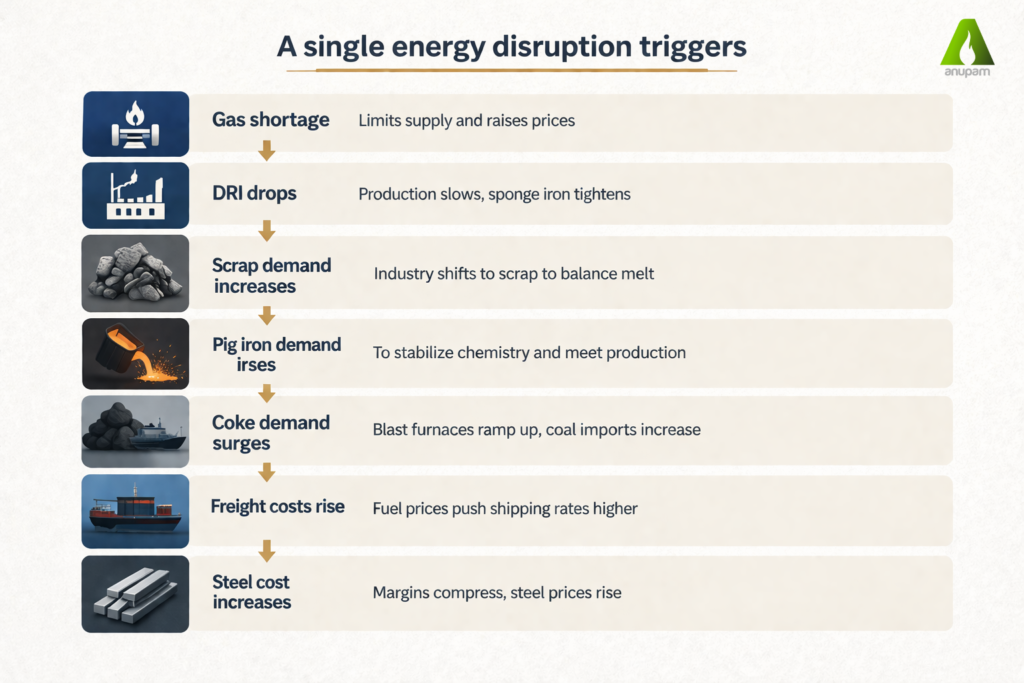
A single energy disruption triggers :
Gas shortage
↓
DRI drops
↓
Scrap demand increases
↓
Pig iron demand rises
↓
Coke demand surges
↓
Coal imports increase
↓
Freight costs rise
↓
Steel cost increases
This chain reaction happens faster than market visibility.
Why Steel Feels It First
Steel sits at the intersection of :
- Energy
- Infrastructure
- Manufacturing
It consumes energy at scale and continuously.
Unlike other industries :
- Steel cannot pause easily
- Furnaces run continuously
- Supply chains must remain active
This makes it the first industry to absorb energy shocks.
What Smart Players Do Differently
Advanced steelmakers respond early :
- Diversify energy sources
- Hedge fuel costs
- Maintain flexible burden mix
- Secure long-term supply contracts
They treat energy as :
not just a cost – but a strategic variable
Energy Controls Steel Before Markets Do
Steel prices do not move first.
Energy does.
By the time steel prices react :
- Energy costs have already shifted
- Raw material markets have adjusted
- Margins have already been impacted